
Bundhosen vs Lederhosen: Which Bavarian Leather Trousers Fit Your Occasion?

What Is the Difference Between Bundhosen and Lederhosen?
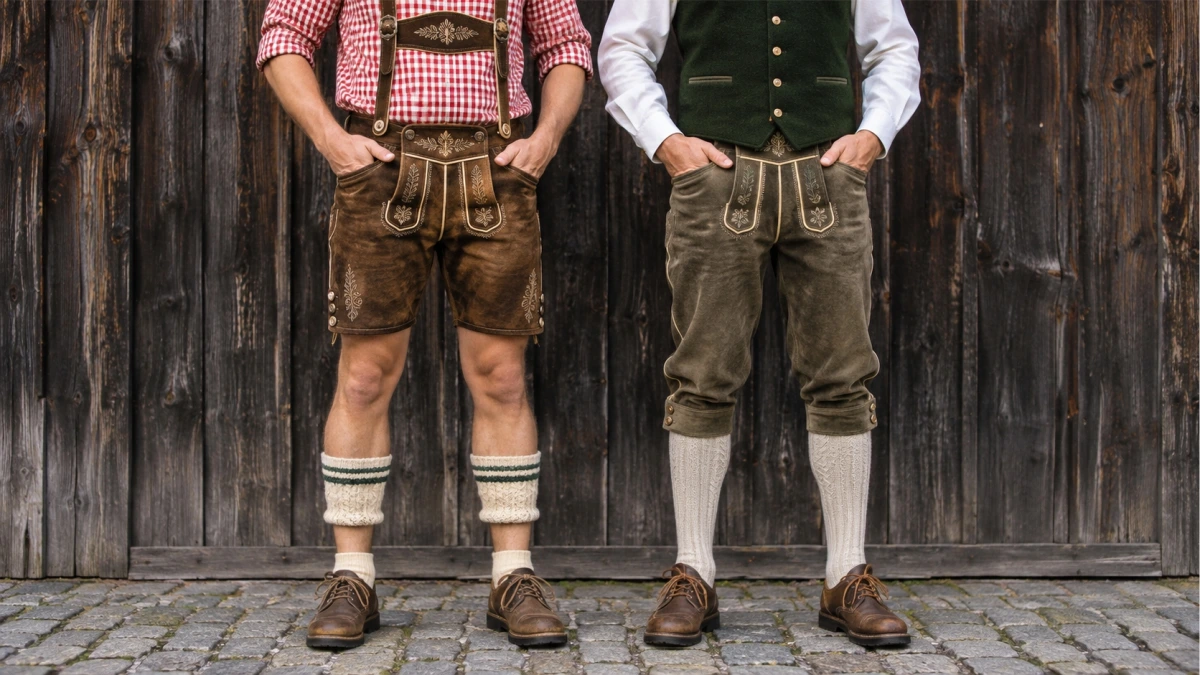
The difference between Bundhosen and Lederhosen is length. Lederhosen are short leather breeches that stop above the knee, while Bundhosen run below the knee to mid-calf and finish in a cuff. That makes Bundhosen the warmer, dressier option and Lederhosen the cooler festival option.
Everything else in this comparison follows from that hem. A fastened cuff at the knee changes how the trousers sit, which socks show, how warm the wearer stays and which events the pair suits. Most comparisons stop at length, but the history behind each cut is where the real choice gets made.
The two styles are best understood as parallel traditions, not a short and a long version of one garment. Lederhosen grew up as Alpine workwear, while Bundhosen carry older, more formal regional roots. When a customer asks me which to buy, my first question is never about personal preference. It is about intended use: where and when the pair will be worn.
That question usually settles things within a minute. Summer beer gardens and packed festival tents point toward short Lederhosen. Bavarian weddings, cold evenings and formal Trachten events point toward Bundhosen. The sections below cover each factor in turn, from the names to price and styling.
How Do Bundhosen and Lederhosen Compare Side by Side?
Bundhosen and Lederhosen share the same leathers and construction but differ in length, formality, warmth and the socks worn with them.
Both garments belong to the same Tracht, and both are cut from deerskin, goatskin or cowhide. They part ways on the leg, and that one change affects every row of the table below.
| Feature | Lederhosen | Bundhosen |
| Hem position | 2–3 inches to 2 to 4 inches above the knee, depending on the workshop | Below the knee to mid-calf, closed with a cuff |
| Feel on the leg | Airy legs and full knee movement | A modest cut that adds warmth |
| Formality | Casual to semi-formal | The dressier option, with more sophistication |
| Socks | Calf-length socks | Knee-high wool socks |
| Typical use today | Festivals and beer tents | Formal events and, increasingly, everyday wear |
The hem figures deserve a second look. Above-the-knee hems vary by about an inch from one workshop to the next, so treat any exact number as a range rather than a rule. What matters more in a fitting is whether the knee ends up exposed or covered.
Why Does the Name Lederhosen Say Nothing About Length?
The name Lederhosen says nothing about length because it simply means “leather trousers” (Leder plus Hosen), so it names the material rather than the cut. Readers asking what is german lederhosen in the broader sense will find the full answer in our separate guide.
That is why shops label the short version Kurze Lederhosen when they need to separate it from longer cuts. Because the word alone covers every length, the two styles get mixed up online far more often than they do in a Bavarian shop.
The short cut began as peasant workwear. Alpine laborers needed tanned leather that could survive field work, and short pairs still come mostly in brown or black hides. Only later did the short pair become an emblem of Bavarian identity.
That shift from work garment to symbol explains much of the nostalgia around short Lederhosen today. Their Alpine origins have been retold in so much regional folklore that many visitors assume the short cut is the only authentic one. The next sections test that assumption.
What Does Bundhosen Mean, and Where Does the Name Come From?
Bundhosen means cuffed trousers, because the German word Bund refers to the band that closes each leg just below the knee.
The name translates as cuffed leather pants, and the knee-length cousin Kniebundhosen literally means knee-cuffed pants. Short Lederhosen end in an open leg opening, while Bundhosen gather the hem into that band.
The closure changes from pair to pair. Some use a button closure and others a small buckle or laces. Many add adjustable straps or elastic waistbands so the cuff sits close around the leg without pinching.
The band was never only decoration. Hunters valued a covered knee when kneeling to track game, because leather shielded the leg from underbrush and thorns. The band also improved cuff durability by protecting the bottom edge of the leg from wear.
How Long Are Lederhosen Compared With Bundhosen?
Lederhosen end above the knee, Kniebundhosen end right at the knee, and Bundhosen finish just below the knee or partway down the calf.
Walk into any Trachten shop and you will usually find four lengths on the rail. The knee-length cut sits between the short and long styles, so it often gets shelved under both names.
English listings also call the longer styles knee-breeches or cuffed breeches, and those labels are used loosely. The real change from one length to the next is a trade between mobility and coverage. Every extra inch of leather costs a little knee freedom and adds a little protection.
Leg coverage is also a personal matter. Men with larger legs or knee scars, or those who simply prefer modesty, often choose the longer cut. Not everyone wants bare thighs in a crowded tent. For larger builds, our size chart has big size lederhosen explained, so you can check the thigh fit before picking a length.
Do Lederhosen and Bundhosen Share the Same Regional Roots?
Lederhosen and Bundhosen come from different corners of the German-speaking Alpine world. Short Lederhosen are rooted in the Bavarian and Austrian Alps, and Bundhosen are tied largely to southwestern Germany.
Historical Trachten documentation treats Bundhosen as a distinct regional tradition of the southwest. Mountaineers in Bavaria and Tyrol also wore cuffed knee-length leather, which is why the long style now turns up on both sides of the Alps.
Regional variation shows most clearly in color and decoration. Bundhosen from the Allgäu traditionally carry bold colors and rich embroidery. Tyrolean pairs lean toward earthy tones and a rustic alpine aesthetic.
Those earthy colors are typically gray, green or blue, a clear contrast with the brown and black of classic short pairs. For many wearers the color is a matter of regional pride as much as taste.
Why Were Lederhosen Cut Short and Bundhosen Cut Long?
Lederhosen were cut short for mobility during mountain work, while Bundhosen stayed long for warmth, protection and formal wear.
Short leather breeches spread among Alpine peasants and farmers in the 18th century, and the reason was practical. Workers and hunters on the steep slopes of the Eastern Alps needed their knees free to climb.
The first written record of the above-knee cut is surprisingly late. August Lewald described it during a tour of the Tuxertal in Tyrol in 1835.
Long leather legs, by contrast, are the older form. People across Europe wore leather trousers below the knee for centuries before the short Bavarian cut appeared. Foresters kept the longer cut because a covered knee simply worked better in the woods.
Do Bundhosen Use Different Materials Than Lederhosen?
Traditional Bundhosen and Lederhosen are cut from the same leathers, but some modern Bundhosen mix in canvas or denim, which short Lederhosen rarely do.
This causes more confusion than any other point in the comparison. Classic Bundhosen are leather. Versions made from a heavier fabric such as wool are a modern branch, not the original garment.
The choice of leather shapes the appearance more than the cut does. Short pairs tend to be sturdier and more slim-fit, while longer pairs sit slightly looser. Both depend on hide quality for their durability.
At the premium end, the most high-quality pieces in either length are usually deerskin. The innovative fabric choices in newer Bundhosen are a fashion branch, not a replacement for leather.
How Do Embroidery Style and Color Set the Two Apart?
Lederhosen usually carry richer, more elaborate embroidery, while Bundhosen tend toward lighter decoration and a quieter overall finish.
On short pairs the embroidery is concentrated on the drop front and side seams. Authentic pairs often carry hand-embossed embroidery, with flowers, leaves and animals stitched into the leather.
Bundhosen usually have a subdued finish, with lighter embroidery, simpler lines and more attention to the closures. The cuff is where the craftsmanship shows, in horn buttons, decorative lacing, ties or small buckles.
Hardware supplies part of the aesthetic appeal on both styles. Metal buttons and engraved motifs on buckles are traditional, and in my experience they are the first detail a buyer inspects up close.
How Did Each Garment Move Between Workwear and Formal Wear?
Lederhosen moved from workwear to festival wear, while Bundhosen moved the opposite way, from aristocratic formal dress toward everyday clothing.
Short pairs kept their rural working-class roots for generations. They were everyday work trousers before they became party clothes, which is why Lederhosen still read as relaxed and festive.
Bundhosen took a different path through aristocratic adoption. Bavarian royalty and nobility wore long leather to set themselves apart, so the style became linked to the upper classes. Ordinary families also kept a pair for Sunday church and market days.
Today the structured silhouette of Bundhosen still signals refined elegance, so they appear at formal balls, cultural events and business events with a traditional theme. Bundhosen have also become part of everyday fashion for many Germans.
How Should the Weather Decide Between Lederhosen and Bundhosen?
Weather is often the deciding factor: wear short Lederhosen on warm days and Bundhosen on cool ones, and consider full-length leather only below 50°F (10°C).
The short cut began as heat management for summer field work, and less leather meant quick drying after rain. That makes Lederhosen the natural pick for summer festivals and open-air folk festivals.
Bundhosen were built for cold weather protection. With long socks and a jacket they work from early fall through late spring, which suits late-fall festivals, Christmas markets and cool autumn evenings.
In my view, an outdoor late-October event calls for Bundhosen. When the weather could go either way, a knee-length pair handles both warm and cool weather reasonably well.
Which Occasions Call for Lederhosen and Which for Bundhosen?
Lederhosen fit lively, casual occasions such as Oktoberfest and summer festivals, while Bundhosen fit formal occasions such as weddings, church services and evening events.
The Oktoberfest season in Munich is the clearest example. Short Lederhosen dominate there, and locals and tourists alike raise their steins in them. Away from the festival grounds, the mix is far more even.
Here is how the occasions usually split:
- Short Lederhosen: beer tents, dancing, festival days and casual outings, where knee freedom matters most.
- Bundhosen: weddings, church services, Trachten balls and evening functions, where a dressier look suits the occasion.
- Either style: hiking and outdoor fall events. Durable Bundhosen even suit horseback riding.
Whichever cut you choose, both carry the same Bavarian heritage, so neither looks wrong at a German event. The task is matching the length to the tone of the day. If your calendar leans toward festival days, our Men’s Lederhosen page is the place to compare short cuts and leathers.
Are Bundhosen Becoming More Popular Than Lederhosen?
Bundhosen are a growing trend, but short Lederhosen remain the iconic look worn by the majority of Oktoberfest attendees.
The sartorial debate has moved quickly. By the 2024 season, Bundhosen had recently gained popularity as a modern interpretation of leather trousers, with more buyers choosing them for the coverage.
The conventional wisdom used to be that Bundhosen were old-fashioned. Now they offer an alternative to the ubiquitous short pair and look fashionable at weddings and Trachten events.
Some of the momentum comes from outside both styles. Cargo Lederhosen and Trachten Jeans now sell as relaxed everyday options, which tells me the market is growing rather than one cut replacing the other.
How Do You Style Lederhosen Differently From Bundhosen?
Lederhosen are styled casually with a fitted checked shirt and short socks, while Bundhosen are styled more formally with a plain shirt, a vest and knee-high socks.
Both outfits start from the same base, hosenträger worn over a button-down shirt, but the details change with the hem. Bundhosen cover more of the leg, so the socks are far more visible and set the tone of the outfit. That is why it pays to compare lengths in our Lederhosen Socks collection before settling on the rest of the outfit.
- Shirt: a fitted check in simple colors for Lederhosen; a solid white shirt or muted colors for Bundhosen.
- Socks: Loferl or calf socks with Lederhosen; long wool socks up to the knee with Bundhosen.
- Shoes: Haferl shoes work with both lengths.
- Layer: a trachtenweste or colorful vest, coordinated with the leather, finishes a Bundhosen outfit.
The simplest rule is that Lederhosen styling leans festive and Bundhosen styling leans semi-formal.
Are Kniebundhosen a Good Compromise Between the Two?
Kniebundhosen are a good compromise because they end right at the knee, handle mixed weather conditions and cost only slightly more than short Lederhosen.
The knee cut suits buyers who want one pair for casual and semi-formal events. It loses a little of the casual and festive feel of short pairs but gains enough coverage for cooler temperatures, which helps when the forecast is uncertain.
Price rises with every inch of leather, as typical US retail tiers show:
| Style | Entry-level cowhide | Mid-range goatskin | Top-tier deerskin |
| Short Lederhosen | $150–$300 | $300–$600 | $700–$1,500 |
| Kniebundhosen | $170–$330 | $330–$650 | $770–$1,650 |
| Full Bundhosen | $180–$350 | $350–$700 | $830–$1,750 |
| Full-length long pairs | $200–$380 | $380–$760 | $880–$1,800 |
Compared with short Lederhosen, the knee cut costs about $20 more at the cheapest end and up to $150 more at the top of the deerskin range. For a pair that covers more occasions, that is a modest step up.
Is the Bundhosen Price Premium Worth Paying?
The Bundhosen price premium is worth paying if you will wear the pair to cool-weather or formal events. Both styles span roughly $100 to $1,500+, and Bundhosen cost only slightly more than short Lederhosen of the same quality.
The gap is modest in real money. A $200 short pair typically has a Bundhosen equivalent at about $220–$230. The difference scales with the hide, so deerskin Bundhosen can cost $100–$250 more.
Cowhide pairs have a sturdier feel and suit occasional wearers, while the higher price tiers buy softer deerskin and finer embroidery. Whatever the budget, make sure the leather is authentic, because material quality decides the longevity of either style.
If the budget covers only a single pair, buy for your most likely use case. For people who attend several German events a year, Bundhosen are often the smarter investment, and anyone building a full Trachten wardrobe should eventually own both. If that describes you, shop bundhosen bavarian clothing by leather grade so the hide matches how often you will wear the pair.
What Do People Get Wrong About Bundhosen and Lederhosen?
The biggest misconception is that Bundhosen are a newer or less authentic version of Lederhosen, when both are equally traditional to different regions and occasions.
The two cuts are not interchangeable, but neither outranks the other. In German-speaking regions the full term Trachten Lederhose covers traditional leather breeches in general. Short pairs are not more authentic, only more local to Bavaria.
A second myth is that Bundhosen look dated. Younger Bavarians have rediscovered them over the past decade, many younger buyers see them as the more polished option, and they can be dressed up or down.
Third, people expect a strict decision framework and worry about looking out of place in the wrong pair. In practice, designers keep releasing contemporary adaptations that combine tradition and innovation, from knee cuts to pairs that reach the ankle. Both garments work as time capsules of older customs, not rulebooks.
What Do Modern Versions of Lederhosen and Bundhosen Look Like?
Modern Lederhosen and Bundhosen keep traditional leather and construction but add new lengths, cleaner tailoring and lighter decoration so they work beyond Oktoberfest.
The newest length variant is full-length Lange Lederhosen, a contemporary choice for cold events. If you mostly attend cold-weather events, shop lederhosen long pants for full leg coverage without giving up traditional leather. Bundhosen themselves now sell as a distinctive alternative to the standard short pair.
The clean lines of Bundhosen suit upscale casual settings, and themed events give people a reason to try both styles. Fewer embellishments and sharper tailoring run through most modern pairs.
Styling has followed. Keep accessories traditional so the trousers stay the hero piece and focal point, and add a wool Janker when evenings turn cool. The complete look now extends into women’s Trachten as well, covered in the questions below.
FAQs
What Shirt and Outfit Work Best With Bundhosen?
A white linen shirt with a vest is the classic Bundhosen outfit, because it matches the trousers’ more formal character. Swabian pairs were sometimes worn with plaid shirts but more often with a plain shirt and red vests, so a red waistcoat adds a historical touch. A crisp shirt in a calm color keeps the look refined, and suspender buttons should be used when the pair has them. For outdoor events, add a Trachten jacket or a longer formal coat.
Which Accessories Belong With Short Lederhosen but Not Bundhosen?
The accessories that belong with short Lederhosen but not Bundhosen are the festival extras: an Alpine felt hat with a feather pin, a Charivari chain and a bottle opener tucked into the knife pocket. A checkered Trachtenhemd is the traditional choice for that classic look, but it looks mismatched with formal Bundhosen, which call for a plain shirt. Bundhosen keep accessories minimal so the cuffed leg and vest carry the outfit.
Do You Need Suspenders With Bundhosen?
You only need suspenders with Bundhosen if the pair has buttons for them. Otherwise a belt is the usual choice, and belts are more common on Bundhosen anyway. Suspenders attach near the front flap and at the back of the waistband, and they frame the pockets and decorative flaps neatly. If those buttons are there, suspenders are part of the traditional look.
Are Bundhosen More Formal Than Lederhosen?
Yes, Bundhosen are generally the more formal of the two, while short Lederhosen read as festive. Bundhosen trace back to aristocrats and the social elite, whereas short pairs turned from workwear into celebratory garb. Both still carry deep cultural significance, and both appear in folk dances and on musicians in traditional Bavarian bands.
Should You Buy Lederhosen or Bundhosen for Oktoberfest?
For Oktoberfest, short Lederhosen are the safer choice, because they are the locally authentic style in Munich and the most comfortable on long, warm days. The festival starts in September, so the opening weekends are often warm, and you may end up standing on benches and doing some active dancing. Over 90% of Oktoberfest visitors dress in traditional clothing, so either style blends in. Bundhosen just stand out more.
What Exactly Are Kniebundhosen?
Kniebundhosen are leather trousers that end right at the knee and close with a cuff, making them the middle ground between short Lederhosen and full Bundhosen. The name combines Knie (knee) with Bund, the band at the hem, which is why the whole family is also called banded pants. They are the most versatile single pair and a good balance for a first-time wearer. They also give a more distinctive look than standard short pairs, and a season in them helps you make an informed decision about a second pair.
Are Bundhosen Warmer Than Lederhosen?
Yes, Bundhosen are clearly warmer, because they cover the legs to below the knee instead of leaving the shins bare. About 60°F (15°C) is the usual cutoff. Below it, Bundhosen with knee-high socks give real insulation, which suits cool late-September and October days and chilly evenings, and the longer cut was made for cooler mountain climates. Above it, short pairs win on breathability and airflow, and a leather jacket can bridge the gap on mixed days.
Where Did Bundhosen Originate?
Bundhosen originated in Swabia and the Black Forest, in today’s Baden-Württemberg, and related cuffed knee-breeches were also worn in the Bavarian and Tyrolean Alps. Wikipedia’s Lederhosen entry notes that leather breeches in that southwestern region were always worn below the knee. Families there have passed the style down through generations.
Can Women Wear Bundhosen?
Yes, women can wear Bundhosen, and women’s Bundhosen are an established, growing category. Women’s cuts are shaped at the waist and suit weddings and formal events. Women wear them less often than short pairs, so they stand out at a local festival among the Dirndl dresses. The main styling difference is the blouse and shoes, which follow the same formal logic as the men’s outfit.
How Much More Do Bundhosen Cost Than Lederhosen?
Bundhosen typically cost 10–15% more than short Lederhosen of the same quality. The reason is the additional leather: a full pair uses roughly 25-30% more hide. The gap widens on deerskin, so compare the same leather grade before relying on price guides or judging a deal.
Can You Wear the Same Shoes With Bundhosen and Lederhosen?
Yes, Haferlschuhe (Bavarian leather shoes) work with both styles, so one pair of traditional shoes covers either outfit. Formal leather ankle boots also work with Bundhosen at dressier events, and they are worn less commonly with short Lederhosen. The real changes are the socks and a shirt, such as linen, that matches the trousers’ formality.
Does Deerskin Feel Different From Cowhide in Either Style?
Yes, deerskin feels noticeably different from cowhide in both Lederhosen and Bundhosen. Deer hide is prized for its softness and flexibility, while bovine hides feel firmer and stiffer when new. The hide also changes how a pair moves and ages. Whichever leather you choose, leather conditioners keep its suppleness, and dry storage prevents mold and mildew.
How Are Lederhosen and Bundhosen Traditionally Decorated?
Lederhosen and Bundhosen are traditionally decorated with embroidered Alpine motifs, buttons and buckles. Local flora and fauna are common, and edelweiss, acorns and oak leaves are the classic motifs on short pairs. Bundhosen lean toward simpler geometric or floral patterns. Embroidery damages easily, so avoid machine washing and use spot cleaning with a damp cloth.
Do Bundhosen Need Different Care From Lederhosen?
Leather Bundhosen need the same care as leather Lederhosen. Only fabric Bundhosen in heavy wool or canvas need a different routine, so check the label first. Short pairs have one practical advantage: smaller leather panels mean easier repair and simpler patching, and less leather dries faster after stream crossings. For leather pairs of either length, gentle hand care is the practical choice.
Can You Have Lederhosen or Bundhosen Custom Made?
Yes, many artisans and tailors make custom Lederhosen and Bundhosen, with your choice of leather and length and personalized embroidery. Custom orders include fit adjustments and embroidery that reflects personal style or family heritage, and a tailored waist is a common request. We cut custom pairs from waist, hip and thigh measurements, so measure carefully and choose a cut that lets you sit down comfortably. Women can also order tailored versions cut for their shape. Between seasons, keep any custom pair in a dry cool place.