
Product categories
- Accessories
- Bundhosen
- Deerskin Lederhosen
- Dirndl
- Dirndl Purses
- Girls Dirndl
- Kids
- Kids Lederhosen
- Lederhosen
- Lederhosen Belts
- Lederhosen Men
- Lederhosen Sets
- Lederhosen Shoes
- Lederhosen Skirts
- Lederhosen Socks
- Lederhosen Suspenders
- Lederhosen Women
- Long Lederhosen
- Men
- Oktoberfest 2026 Sale
- Plus Size Dirndl
- Plus Size Lederhosen
- Trachten Jackets
- Trachten Shirts
- Trachten Vest
- Uncategorized
- Women
Filter by price


Authentic German Dirndl with Stunning Black & Beige
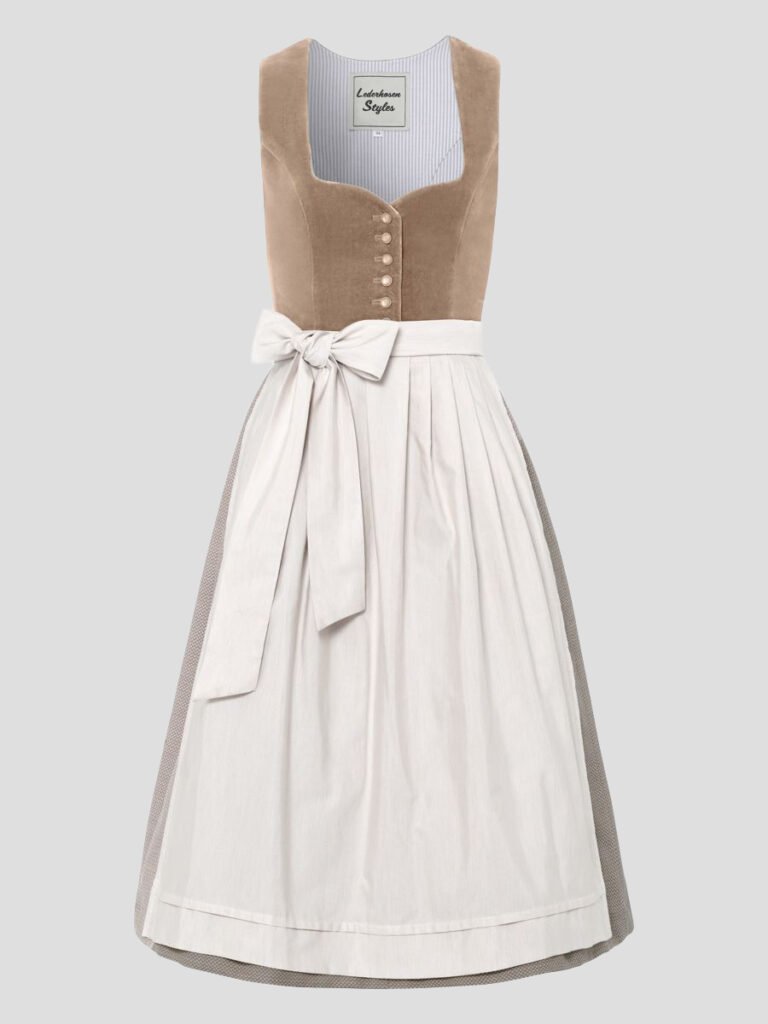

Classic Dirndl Dress with Beige Bodice & Cream Skirt
What Is a Plus Size Dirndl?
A plus size dirndl is a traditional Bavarian dress whose bodice, waist and skirt are drafted from the start for a fuller bust and hips, rather than a regular dirndl simply made bigger.
Most fitting complaints I hear trace back to a dress that was scaled up from standard patterns. The bodice gapes at the side seams, the waist seam drifts toward the hips, and the bust feels pressed flat. A true plus size cut moves the shaping instead of just widening it.
Plus-size Trachten is no niche at Oktoberfest; women of all body types wear a dirndl into the tents and nobody checks the label. The real question is whether a dress comes in true extended sizes made with the same care as the smaller range, or relies on costume-tier shortcuts such as elastic panels and unlined bodices.
My first advice never changes: forget your usual dress size. Dirndl sizing runs on bust and waist measurements, and regular designs from fashion labels rarely line up with it. If your shape sits between rows on the chart, our custom order service lets you send measurements before any fabric is cut.
What Makes a Plus Size Dirndl Cut Different From a Stretched Standard Pattern?
A plus size dirndl cut differs from a stretched standard pattern because the shaping is redrawn for fuller body shapes, not added in equal amounts to every seam.
When a factory tries to enlarge a size 38 into a size 54, every panel grows by the same margin. The result is spare fabric at the upper back and too little at the bust, and the waistline slides downward. Properly drawn patterns do the opposite: they add room only where a fuller body needs it.
A good plus size bodice is built to emphasize the waist and keep the seam at the natural waist, which is the whole point of traditional Bavarian design. At the back, longer lacing channels for the Schnürung let the bodice adjust instead of relying on one fixed seam.
Decoration gets the same treatment. Traditional German embroidery and trims are placed proportionally on the larger panel, so a flower border doesn’t stop halfway across the front, and the apron ties are cut long enough for a full bow. Fitted plus size Tracht has always existed; it was 20th-century factory grading that made one pattern for everyone the norm.
Which Fabrics and Construction Details Should a Plus Size Dirndl Have?
A plus size dirndl should be made from the same traditional fabrics as the standard range, with seams and closures reinforced for the extra strain a larger bodice carries.
Construction quality shows first at the stress points. Look for double stitching at the side seams, then check the back: proper eyelet reinforcement stops the lacing holes tearing after a few wears. Cheap retailers often drop both on their bigger sizes to save cost. A quality dirndl dress keeps both details in every size, so check for them before you buy.
Good plus-size construction also means the bodice holds shape after you sit, eat and stand up again. A firm interlining keeps the front from creasing across the stomach during a long day in a festival tent, which is where flimsy dresses give up first.
Fabric weight should follow the event. For everyday wear and casual fairs, a plain natural weave stays cooler throughout the day. For formal ceremonial events, heavier premium materials with a soft sheen look richer and drape better over a full skirt.
How Do You Measure for a Plus Size Dirndl and Read the Size Chart?
You measure for a plus size dirndl by taking your bust, waist and hip in centimetres and matching all three to the chart, because dirndl sizes for fuller figures are set by body measurements, not letter sizes.
The bust comes first, since the bodice has to support the bust without flattening it. Then look at your bust-to-waist gap: two women with the same bust can need different sizes if one has a much smaller waist.
German plus sizes run through German 52 to 60, which roughly equals US 20 to 30 and UK 24 to 34. The numbers vary between makers, so treat the table below as a typical guide and the chart on each product as the final word.
| German size | Bust (cm) | Waist (cm) | Hip (cm) | US | UK | Letter |
| 52 | 125–130 | 107–112 | 128–133 | 20–22 | 24–26 | 2XL |
| 54 | 131–136 | 113–118 | 134–139 | 22–24 | 26–28 | 2XL |
| 56 | 137–142 | 119–124 | 140–145 | 24–26 | 28–30 | 3XL |
| 58 | 143–148 | 125–130 | 146–151 | 26–28 | 30–32 | 3XL |
| 60 | 149–154 | 131–136 | 152–157 | 28–30 | 32–34 | 4XL |
Above a 154 cm bust or a 136 cm waist, a standard chart stops and custom work starts. The bodice should feel snug on first try; lacing gives some adjustment range, but it can’t rescue a dress sized two steps too small.
Which Dirndl Length Flatters a Fuller Figure?
For most plus size women, a dirndl that ends halfway down the calf is the most flattering length, because the skirt can fall naturally over fuller hips without cutting the leg at its widest point.
Dirndls come in three traditional lengths: short, middle and long. A skirt of about 70–80 cm lands near mid-leg on an average height, and taller women can go to 70–82 cm for the same line. Either gives an elegant silhouette that moves well when you walk or sit on a bench.
| Length | Where the hem lands | When to wear it |
| Short | Just above the kneecap | Daytime beer gardens and summer fairs |
| Middle | Halfway down the calf | Most festivals, church fairs and club events |
| Long | Ankle to floor | Weddings, balls and formal evenings |
Short styles look playful but show the knee, where many larger buyers feel least at ease. Height changes everything, so a tailor-made hem is worth asking about. Makers who offer non-standard skirt lengths with hand-finished hems can set the hem where it complements your figure rather than where the pattern assumes.
Can You Order a Custom Plus Size Dirndl?
Yes, a custom plus size dirndl can be drafted from your own body measurements when the standard size chart doesn’t match your full figure.
Custom work makes sense in three cases: your numbers sit beyond the chart, your proportions don’t line up with one row, or you want a full-length or ankle-length skirt for a height the stock dresses don’t suit. In each case the pattern is designed separately around you, not stretched from the nearest size.
To start, contact us with your bust, waist, hip, height and the hem length you want. Buyers with larger measurements sometimes find that selected models in the stock range fit with small changes, so it’s worth checking those first.
A custom-made dress takes longer than a stock one. Ask for an estimated finish date if you have an event coming, and pick high-quality fabrics, since a bodice cut for you is worth making to last. If your weight can fluctuate through the year, ask for a little extra seam allowance at the sides.
Which Plus Size Dirndl Should You Wear for Each Occasion?
The occasion decides both the length and the fabric of a plus size dirndl: shorter dresses for daytime fairs, calf-length dresses for festivals, and long, silky dresses for weddings and balls.
For Oktoberfest and other Volksfeste, a midi is the practical pick, since it lets you sit on a bench, climb a step and still look neat by evening. The classic mid-calf shape is also the dress I recommend most for a first purchase. If you’d rather wear trousers to the tents, you can shop women’s plus size lederhosen instead.
A mini with a well-fitted bodice suits casual summer festivals and the modern Wiesn style that younger crowds wear. Pair it with a lighter apron so the outfit doesn’t feel heavy in the heat.
For Bavarian weddings and Trachtenbälle, a maxi in a silk-blend turns a dirndl into evening wear. Any festive occasion after dark calls for deep jewel tones or black, while pastels belong to spring and summer daytime events.
How Does the Lace-Up Back Help a Plus Size Dirndl Fit?
A laced back lets a plus size dirndl open or close by a small margin, so the bodice still fits on a day when your body feels different from the morning you bought it.
That margin matters most during hours of standing and dancing, followed by sitting down to eat. Lacing leaves some stretch room in the back, so you can loosen a notch without touching the front fastening.
The lacing only works if the base is sound. A reinforced waistband spreads the pull so the fabric doesn’t pucker, and stronger eyelets keep the laces from ripping through after a season of traditional events. Together they give a laced bodice its structural integrity and long-term durability.
Some cheaper plus size dresses swap lacing for elastic and adjustable waistbands. They work for a costume party, but the bodice loses its line once the elastic stretches. Proper lacing means no body is excluded from a close fit, and you can still dance without the bodice riding up.
Should You Buy a Plus Size Dirndl as a Complete Set?
Buying a plus size dirndl as a set is the easiest route for a first dress, because the blouse and apron are already matched in proportion to the bodice.
A set with the blouse and apron included removes the most common sizing mistake: a Dirndl blouse bought separately in a standard letter size that pulls tight under a larger bodice. In a set the pieces are graded together, and proportionally cut aprons cover the right width of skirt.
Sets come in a huge range of colors, from solids to smaller patterns such as tiny florals and checks, which suit a fuller figure better than oversized prints.
Check the blouse in any set: a structured blouse with a reinforced neckline holds the bust in place better than thin lace. Add heavier jewellery rather than delicate pieces that disappear against a larger bodice, and you’re ready to celebrate in style.
How Do You Style a Plus Size Dirndl?
Style a plus size dirndl around a visible waistline, so the blouse, apron and shoes frame the waist instead of competing with it.
A dirndl is naturally flattering on curves because the bodice nips in and the skirt flares out. Keep the skirt in a solid fabric or a subtle pattern, and let the apron carry the stronger colour.
Blouse sleeves change the whole outline. Three-quarter sleeves or long sleeves balance the upper arm and keep you warm in a cool evening tent. A hem at mid-calf lengthens the leg, while a hem above the knee needs a small heel to stay balanced.
Finish with two or three accessories, kept coordinated with the apron and chosen so the outfit feels uniquely yours:
- Belt: a slim decorative belt over the waist seam sharpens the line between bodice and skirt.
- Headbands: a braided or floral band lifts attention toward the face.
- Hat pins: on a felt hat, a pin or feather adds height without adding bulk.
Have Plus Size Dirndls Always Been Part of Bavarian Tracht?
Yes, the dirndl began as a working dress sewn to fit the woman who wore it, so extended sizes are part of the tradition rather than a modern add-on.
Its three parts haven’t changed: the fitted Mieder (bodice), the gathered Rock (skirt) and the Schürze (apron). A plus size dress keeps all three, which is how it keeps its cultural integrity.
In Bavarian villages, Tracht clubs called Trachtenvereine wear dirndls through the whole Trachten season, from spring parades to Kirchweih in autumn, and their members come in every shape. Watching a club line up at a church fair, I’ve never seen size decide who wears the dress well; fit does.
One custom applies at every size: the apron bow carries a relationship code. A bow on the left says single and one on the right says taken or married. A knot in the centre is usually read as undecided, and a bow tied at the back is traditionally worn by widows and waitresses.
Plus Size Dirndl FAQs
What Sizes Count as Plus Size for a Dirndl?
A dirndl counts as plus size from about German size 46 upward, where bust measurements start around 100–104 cm. German shops label the larger range Übergröße Dirndl, and charts vary by maker: size 52 can start anywhere from about 112 cm to 125–130 cm bust. Converted, the range covers roughly US 20 to 30 and UK 24 to 34, or letter sizes 2XL, 3XL and 4XL. If your bust or waist exceed the top row, work in centimetres and ask about a custom cut.
Why Do Some Plus Size Dirndls Fit Poorly?
Plus size dirndls usually fit poorly when they are graded straight up from a standard collection instead of being drawn for a fuller body. Grading sizes 32 to 50 upward with standardised sizing adds the same width everywhere, which causes most fit problems: a gaping neckline, a sliding waist and a tight bust. A proper cut uses redrafted bodice darts and new seam curves around the bust. Ask whether the plus range gets identical craftsmanship, because fit and construction matter more than the number on the label.
What Is the Best Dirndl Length for Plus Size Women?
The best dirndl length for most plus size women is the calf-length Wadenlange cut, the safest choice for almost any event. Midi skirts measure roughly 65–85 cm, so the hem can be matched to your height without leaving the calf. Long dresses, called Lange dirndls, measure from 85 cm and often reach floor-length on shorter women, so they work best for formal evenings. If you only buy one dirndl, the calf-length cut covers festivals, church fairs and weddings alike.
What If Your Measurements Fall Outside the Plus Size Chart?
If your measurements fall outside the plus size chart, a custom-cut dirndl made to your numbers is the answer. Standard plus ranges usually top out at German size 60, around 149–154 cm bust. Anyone outside this range, or whose bust and hips don’t sit in one row, can have a dress made on request. Follow the size guide when measuring, send the numbers, and ask for the production timeline before ordering for a fixed date.
How Should a Plus Size Dirndl Fit?
A plus size dirndl should fit closely through the bust and waist without pressing, with the skirt hanging freely from the waist seam. The hook-and-eye bodice closures should meet without strain, and deeper shaping at the bust should lift rather than flatten. Blouse sleeves should move without dragging the bodice. If you’re between sizes on a dress with a lace-up back, the lacing gives several centimetres of play, so the smaller size often works; on a dress without lacing, go one size up.
How Do You Choose the Right Plus Size Dirndl Size?
Choose a plus size dirndl size by your bust circumference at the fullest point, then check your waist and hip against the same row. Your everyday clothing size won’t help, since a dress labelled size 54 in one shop can measure differently in the next. Take the smaller size only when the dress laces at the back; otherwise pick the larger one. Send us your numbers to confirm before you order.
Which Blouse Works Best Under a Plus Size Dirndl?
The best blouse under a plus size dirndl has built-in support or light boning at the neckline, so it lifts the bust instead of letting it slip under the bodice. Check that the armholes are cut high and the shoulders sit flat, or the blouse will bunch under the straps. Dirndl Sets give a ready-made combination with a matching blouse, and complete outfits take the guesswork out of colour. A chunky Charivari-style chain suits the neckline better than a fine pendant.
Is a Plus Size Dirndl Comfortable Enough for Oktoberfest?
Yes, a plus size dirndl gives a comfortable fit for a full Oktoberfest day when the bodice is sized correctly and the fabric breathes. Cotton and linen are the most breathable fabrics for a warm tent, while silk looks better at evening events but has less breathability. The same dress carries over to spring festivals, folk festivals and photo occasions, so a well-fitted one earns its price over many outings.
Can You Exchange a Plus Size Dirndl That Doesn’t Fit?
Yes, a ready-to-wear plus size dirndl that doesn’t fit can usually be swapped for the correct size under our return policy. Keep the tags on and try it over the blouse you’ll wear, because a poor fit shows within minutes as discomfort at the waist or bust. Custom-made dresses usually fall outside a standard exchange, so measure twice before ordering one. If you’re unsure, our customer support team can walk you through the return process or suggest a size first. Cheap polyester blends may pass for one night, but a natural-fibre dress fitted properly gives years of wear.