
How to Identify Genuine Bavarian Lederhosen: Authentic vs Fake Pairs Explained

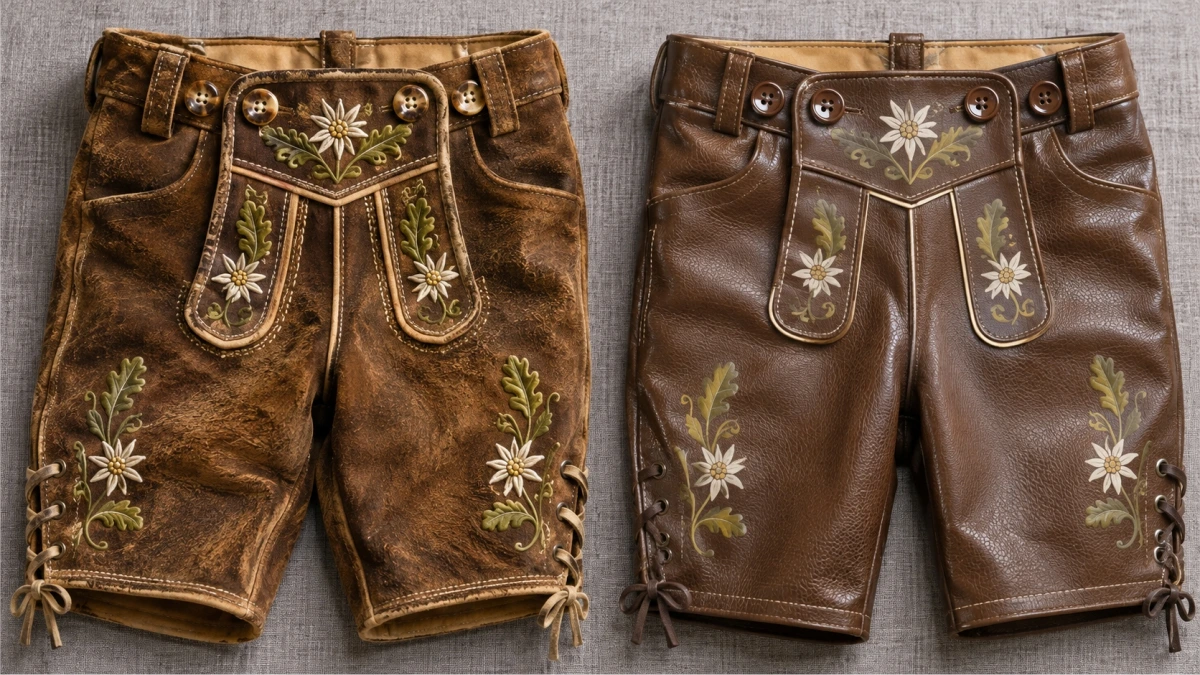
How Do You Identify Genuine Bavarian Lederhosen vs Fake Ones?
Genuine Bavarian Lederhosen are cut from real deerskin, goatskin or cowhide and finished with stitched embroidery and natural hardware, while fake Lederhosen use synthetic material such as PU leather, printed designs and plastic buttons. The quickest way to identify a genuine pair is the leather type named in the listing, because every other difference follows from the material.
Most buyers I speak with don’t get caught by an obvious fake. They get caught by a pair that looks right in a photo and feels wrong in the hand. The hide, the embroidery work, the buttons and the seams each tell part of the story, and a fake usually fails on several of them at once.
Price matters too, but a very low price is a clue, never a verdict on its own. The sections below take each sign in turn, from the hide itself to the seller transparency you should expect before you add to cart.
The stakes are practical. A genuine pair can serve you for decades and even pass from father to son, while a synthetic pair often won’t make it through a second season.
What Leather Are Genuine Bavarian Lederhosen Made Of, and What Do Fakes Use?
Genuine Bavarian Lederhosen are made from real animal leather, while fake Lederhosen use synthetic materials built to copy the look of leather rather than its behavior.
The three traditional hides each have a clear role. Deerskin is the softest of the three, goatskin offers a balance of softness and durability, and cowhide has the longest break-in period but outlasts almost anything. All three are authentic, and all three are an expensive raw material.
Fakes come from a very different supply chain. Demand from Oktoberfest events in over 40 countries created a market for cheap imitations that only need to survive a few product photos. Most counterfeit lederhosen are polyester or coated fabric with a printed grain.
That difference decides longevity. Leather breathes, softens and lasts for years, while synthetic material stays the same until it cracks. When a customer brings me a doubtful pair, the material is the first thing I check, and it usually settles the question.
A smell test backs this up. Real leather carries an earthy aroma from tanning, while synthetic fabric gives off a faint chemical smell.
How Do You Check for Real Leather by Hand?
You can check for real leather by hand by feeling the grain, pressing the surface, looking at a cut edge, dropping water on it and smelling it.
None of these checks needs tools, and together they take less than a minute in a shop:
- Grain: run your hand over the surface. Real hide shows natural grain and surface imperfections, while a uniform surface points to synthetic material.
- Press: push a thumb into the leather. Genuine leather wrinkles and then relaxes back into shape, while faux leather stays flat or cracks.
- Edges: look at a cut edge. Real leather is built from fibers that fray slightly, which shows clearly on cow suede, while machine-made sheets have a perfectly clean edge.
- Water: drip a little water on a hidden spot. Leather soaks it up within seconds, while PVC and other synthetics let it sit on top.
- Smell: real leather smells earthy, while polyester blends and coated fabrics smell faintly of chemicals.
One caution from experience: water can mark light suede, so try it on an inside seam. Subtle variation from one panel to the next is a good sign, not a defect.
Which Words in a Listing Reveal Fake Lederhosen?
A listing reveals fake Lederhosen when it describes how the material looks instead of naming the hide, while a genuine listing states the exact leather type in plain words.
Vague terms about appearance or “quality” tell you nothing about what the trousers are made of. A generic term such as “premium” or “traditional” is marketing, and first-timers tend to read it as a promise.
Honest Trachten shops name the genuine animal hide and often the material origin too. Even a budget pair in pig split leather should say so plainly, because a cheaper hide is not the same thing as a fake.
When the description stays vague, check online reviews for photos and comments on the material, especially when the retail price looks generous. If nobody mentions leather, you risk an overcharge for synthetic fabric.
Complete your authentic Bavarian look with 100% original, high-quality Lederhosens, Dirndls and many more accessories from Lederhosen Styles


Handcrafted Bavarian Lederhosen Shoes Dark Brown


Classic Lederhosen Outfit in Weathered Oak Brown


Authentic Lederhosen Vest in Grey with Velvet Collar


Elegant Traditional Lederhosen Vest in Blue Velvet Finish
How Does Fine Embroidery on Genuine Lederhosen Differ From Costume Embroidery?
Fine embroidery on genuine Lederhosen is stitched into the leather and has visible texture, while costume embroidery is usually printed, patched on or reduced to a flat outline.
On an authentic pair the motifs carry cultural significance. A stag, oak foliage and floral motifs such as Alpine flowers each come from regional tradition, and a skilled embroiderer spends real time on every panel.
Costume makers copy the outline, not the work. The pattern is simplified, the colors look artificial, and a print replaces thread, which is decorative construction rather than craft. Machine work of this kind looks identical on every pair because every stitch is the same.
The fastest check is to ask for close-up shots of the front panel. Sellers who are proud of the needlework photograph it closely. If every image is taken from a distance, that tells you something about the heritage behind the pair.
Which Traditional Lederhosen Colors Point to a Genuine Pair?
Genuine Bavarian Lederhosen come in the natural colors that tanned leather takes on, so a pair in a loud, fashion-led color is usually a costume rather than a traditional garment.
The palette goes back to the garment’s roots. In the 18th century, Lederhosen were outdoor work clothing for Bavarian peasants, and dark, earthy leather hid mud and hard wear far better than anything light.
When the upper class later took up the garment for leisure, the cut became finer but the colors stayed close to the hide. That is why a deep brown is still the color most people picture, and why most workshops build their range around a handful of natural tones.
Thinking of the pair as Bavarian workwear makes the color test quick. Real leather dye sinks into the hide and looks slightly uneven across panels, while a synthetic coating takes any color evenly, including shades no tanner would choose. I treat an odd color as a reason to check the material line, not as proof on its own.
What Do the Seams and Stitching Tell You About a Pair?
Seams show whether Lederhosen were built for wear: authentic pairs have strong, tight seams with clean finishing inside, while costume pairs use thin stitching that starts pulling after a day of movement.
Turn the pair inside out before anything else. The inside construction of a genuine pair is as neat as the outside, with even stitch spacing, matching thread colors and no stray ends, because the maker followed traditional methods all the way through.
Costume pairs save money where nobody looks. Thin thread around the seat and the rear waistband gives way after long hours of sitting on benches and dancing, and the result is surface damage along every seam.
The same shortcut shows in the decoration. Embroidery that is screen-printed, heat-transferred or sewn on as a fabric patch starts to lift and separate from the base material after a few hours of movement.
I always look closely at the side seams on a hand-stitched pair, because small irregularities there point to a person rather than a production line. Perfectly identical stitching on a cheap pair points the other way.
What Does the Hardware Reveal About a Pair’s Authenticity?
Hardware reveals authenticity quickly: genuine Lederhosen use natural or metal fittings with real heft, while costume pairs use lightweight fittings that crack or bend under strain.
Pick up the trousers and feel the visible weight of the fastenings. Genuine buttons are cut from natural material and each one looks slightly different, while the buckles and clips on a real pair are solid metal hardware built for repeated wear.
The suspenders are where many fakes give themselves away. Authentic adjustable suspenders fasten with leather loops or solid clips sewn into the waistband, while costume versions rely on thin elastic and plastic snap clips.
Those cheap fittings rarely survive a full festival day. Heat and constant movement make them snap or fade. The same goes for a crest belt: a real one has a solid metal buckle with weight to it, while a costume version feels hollow. If a listing doesn’t name its button material, ask the seller, and treat a vague answer as a sign the buttons are plastic.
Which Structural Details Do Costume Lederhosen Skip?
Costume Lederhosen usually skip the working parts of the garment, especially the functional drop front, the back adjustment and the decorative stitching along the side seams.
Start at the inseam. Authentic makers use either a vertical seam or the horizontal Tellernaht, a construction specific to traditional Bavarian pairs. Costume pairs use whatever is fastest to sew.
Then check the openings. On a real pair the pocket openings are deep enough for a phone, the drop front opens on horn-style buttons, and the waistband has lacing at the back for fit. These are also the stress points that take the most strain when you sit, bend and dance.
Fakes often show pockets in the photos that turn out to be stitched closed, so functional pockets are worth asking about. The side seam tells you the most about the maker’s effort, because traditional pairs carry several rows of decorative stitching there and more rows mean more artisan hours.
How Do Real and Fake Lederhosen Change After Months of Wear?
Real Lederhosen soften, shape themselves to the wearer and gain depth of color with wear, while fake Lederhosen stay the same until they crack along the seams.
This is the slowest test but the most reliable one. Genuine leather has natural breathability, so it handles heat and sweat and keeps improving, and a new pair settles into its shape within 20–30 wears. The leather stretches a little where you move most.
Synthetic pairs go the other way. The coating stays stiff, the cheap polyester lining traps heat on a warm afternoon and pills where your legs rub together. You won’t see any of that in a listing photo.
That is why comfort over time is the real dividing line. I’d rather judge a pair after its third Oktoberfest than after its first afternoon.
What Price Range Usually Signals a Fake Pair?
A price far below what genuine leather costs to buy and sew usually signals a fake pair, though price alone never proves that a pair is real.
Every authentic pair carries fixed costs: the hide, the needlework and the skilled craftsmanship of putting it together. A pair hanging on a Halloween store rack for $29.99 cannot cover those costs, so it is not usually leather at all.
The opposite trap matters just as much. A high price does not guarantee real leather, and lower quality hide still gets sold under a reassuring label: cheap “genuine leather” is often the lowest grade of real hide. That’s why the listing’s material line always comes before the price tag.
I treat a low price as a reason to read the description twice. Sales and secondhand pairs exist, so a bargain on a tight budget can be genuine, but a pair priced like a single use costume usually is one.
Where Should You Buy Authentic Lederhosen to Avoid Fakes?
Buy authentic Lederhosen from specialist Trachten retailers and traditional workshops, because fake pairs are sold mostly through Halloween and party shops and on large online marketplaces.
Party shops are honest about it, because they sell costumes and call them costumes. Big marketplaces are harder, since real and synthetic pairs sit side by side and the listings often look alike. Read comments from verified buyers before trusting a photo.
A specialist seller should show verifiable Trachten heritage and customer reviews with photos of the actual garment. The locals you see at Bavarian festivals mostly buy from workshops and family Trachten houses, many of which have sold the same styles for generations.
Country of origin helps but doesn’t settle it. Plenty of genuine pairs are made across Europe and beyond with traditional methods, so the seller’s openness matters more than the flag on the label.
What Should a Pre-Purchase Authenticity Checklist Include?
A pre-purchase checklist should confirm the leather type, the embroidery method, the hardware, the color, real close-up photos and a seller you can verify.
Run through these points before paying:
- Leather: the product specifications name the hide, such as genuine goatskin, real deerskin or 100% cowhide leather.
- Wording: no leather-style or leather-look phrasing anywhere in the title or description.
- Hardware: antler horn buttons and brass buckles, not plastic.
- Front and back: a working Latz that opens on buttons, plus back lacing for adjustment.
- Color: traditional shades such as black, tan, grey or dark brown leather rather than a fashion color.
- Seller: a returns policy and a trading history you can check.
If two or more of these points come back as red flags, I’d move on, however good the photos look.
Where you shop changes the odds. Specialty Bavarian retailers and master craftsmen sell genuine pairs at every budget, costume stores sell costumes by design, and generic marketplaces mix both, so the checklist matters most there.
Why Do Authentic Lederhosen Matter More Than a Costume Pair?
Authentic Lederhosen matter if you will wear them more than once, because a genuine pair costs less per wear and lasts for years, while a costume pair only makes sense for a single themed night.
The cost-per-wear math makes the case plainly. A €200 pair worn once a year for 20 years works out at €10 per wear. A €40 costume pair that falls apart after two outings comes to €20 per wear.
There’s also cultural respect to think about. Lederhosen have grown from regional dress into a global symbol of Bavaria, and at a German wedding or a traditional festival, a synthetic pair gets noticed by the people who grew up wearing the real thing.
Here is roughly what each price band buys:
|
Price band |
Leather |
Build and lifespan |
|
Under €50 / $55 |
Faux leather |
Costume build that won’t last one full season |
|
€80–€130 |
Genuine leather |
Entry-level, basic construction |
|
€150–€250 |
Goatskin or quality cowhide |
Hand embroidery, lasts for years |
|
€250–€400 |
Deerskin |
Traditional construction and fine detail |
|
€400+ |
Chosen to order |
Made-to-measure, heirloom quality for generations |
How Do You Spot Fake Lederhosen From Product Photos Alone?
You can spot fake Lederhosen from product photos by checking for real close-ups, natural texture and believable hardware, because sellers of synthetic pairs avoid images that show those details.
Zoom in on the leather first. Genuine hide shows small creases, bumps and frayed edges at the cut lines, while a printed repetitive surface looks the same across every panel. A product sold for its authentic look is describing a photo, not a material.
Then zoom in on the needlework. Real embroidery has three-dimensionality, with raised thread and a soft sheen that changes with the light. Flat color with sharp printed edges is a giveaway.
Watch the color as well. Bright colors or unnatural colors on something sold as hide usually mean a coated synthetic, or a photo edited so heavily that you can’t judge the material.
Finally, notice what’s missing. Sellers who list a premium material without any material disclosure usually skip the back and inside views as well, and in my experience the missing photo is often the most informative one.
When Is a Costume Pair the Smarter Buy?
A costume pair is the smarter buy when you need Lederhosen for a single short event and have no plans to wear them again.
For a one-off themed party with friends, a disposable costume does the job, and a party-shop Alpine hat finishes the look. Nobody expects traditional dress at an office Halloween night, and a synthetic pair is a functional option on a limited budget.
There is no rule that makes leather mandatory, even at Oktoberfest. The calculation changes once you attend festivals regularly, because then the cheap pair becomes the expensive one.
My advice to customers is simple. If there’s any chance you’ll go back next year, make sure the next pair you buy is genuine leather.
How Do Authentic and Costume Lederhosen Compare Side by Side?
Authentic and costume Lederhosen differ in material, surface, embroidery, hardware and aging, and every one of those differences favors leather for anyone who will wear the pair more than once.
|
Feature |
Authentic Lederhosen |
Costume Lederhosen |
|
Material |
Cowhide, goatskin or deerskin |
Polyester, PU, PVC or synthetic fabric |
|
Surface |
Irregular patterns in the grain |
Smooth, printed texture |
|
Embroidery |
Stitched into the leather |
Printed, patched or simplified |
|
Hardware |
Horn buttons, bone or wood, metal suspender clips |
Plastic parts and flimsy clasps |
|
Aging |
Softens and develops character |
Cracks or discolors |
|
Best for |
Festivals and a long-term investment |
A one-time party lasting a few hours |
If you’re buying your first genuine pair, cowhide suede is the practical starting point: tough, traditional and without the premium price of deerskin.
Goatskin sits in the middle ground for anyone who wants a softer, lighter feel without paying for deerskin.
FAQs
Can You Tell Faux Leather Lederhosen Apart in an Online Listing?
Yes, you can usually tell faux leather Lederhosen apart online by reading the wording and the photos together. A title promising a leather effect or vegan leather describes a synthetic pair, whatever the photos suggest. In the images, real hide shows small imperfections and pores, while coated fabric has smooth edges and a shine like plastic. Be wary of studio shots taken from one angle or images that look heavily filtered. If the listing won’t show the leather up close, keep looking.
How Should Authentic Lederhosen Fit When New?
Authentic Lederhosen should fit snug but not restrictive when new, because the leather loosens slightly as it settles. From the first wear, the hide starts to mold to your shape, and after 2–3 wears it begins to conform to how you sit and move. Give a pair time to break in before judging the fit, and use the adjustable buttons at the back for small changes. A synthetic pair that feels baggy on day one stays that way and never gives you real freedom of movement.
Is It OK to Wear Synthetic Lederhosen to Oktoberfest?
Yes, synthetic Lederhosen are allowed at Oktoberfest, and nobody checks the material at the entrance. There’s no shame in it, and plenty of first-time buyers start that way. If you wear them respectfully and with real appreciation for the tradition, the outfit is welcome. The practical downside is wear: after a day of benches and dancing, cheap pairs often show loose threads at the crotch seam.
Does a “Genuine Leather” Label Guarantee Quality?
No, a “genuine leather” label confirms real leather but not good leather, because the term also covers the lowest grades. Some of it is bonded leather made from pressed strands of hide fiber, which won’t age like a solid skin. Neither that tag nor a Made-in-Germany sticker works as a full authenticity signal, so look for a named hide or a “100% pure leather” statement with the animal listed. At home, a few water drops tell you more: real hide shows quick absorption, while a coated surface leaves a puddle.
Are Lederhosen Made in Germany Always Authentic?
No, Lederhosen made in Germany are not automatically authentic, and many genuine pairs are made elsewhere. Traditional workshops in Munich, Berchtesgaden and Garmisch-Partenkirchen set a high bar, and shops in Salzburg across the Austrian border share the same tradition. What makes a pair authentic is the leather, the stitching and the construction standards, wherever the workshop sits. In the hand, real horn buttons feel heavy and cool, and their sturdiness under a firm tug says more than a flag on the label. Bespoke workshops will show you exactly how a pair is made.
What If You Already Bought Costume Lederhosen?
If you already bought costume Lederhosen, wear them for what they are and buy genuine leather next time. Most mass-produced synthetic pairs only last a few outings, so keep them clean with a damp cloth and spot cleaning, and keep them away from excessive heat. When you upgrade, check the vendor’s reputation, and trust claims about certificates of authenticity or limited-edition runs only when the seller can back them up. A genuine pair repays its cost in comfort alone.
Do Women’s Lederhosen Follow the Same Authenticity Rules?
Yes, women’s Lederhosen follow exactly the same authenticity rules as men’s: real leather, stitched embroidery and solid hardware. The embroidery often leans toward edelweiss and other Alpine motifs, while men’s pairs more often carry oak leaves and deer antlers. Oak leaves traditionally stand for Bavarian strength and edelweiss for Alpine purity, so the motifs mean something on either cut. Fit matters as much as on men’s pairs, so compare your size against the seller’s measurements.
Are Cheap Lederhosen Ever Real Leather?
Cheap Lederhosen are rarely real leather, because the hide alone costs more than the full price of most budget pairs. A pair in the $30-60 range is almost always synthetic, and an offer that looks too good to be true usually is. Exceptions come from clearance sales and used products, so a quick wrinkle test and a feel for natural pebbles in the surface are worth doing. Some low-cost pairs are real but made from leftover hide scraps, which sit far below full-grain leather in quality.
Does Every Authentic Leather Type Feel the Same on Day One?
No, the three authentic leathers feel quite different on day one, but all of them improve with wear. Deerskin is lightweight and soft from the start, while cowhide is thick and needs time. Look closely and you’ll see natural grain variation in all three, which is the clearest sign they’re real. Over years of repeated wear, each hide develops a patina and a soft sheen, and a pair worn regularly for 5 years fits better than it did when new. That graceful aging is something no synthetic can copy.
Why Do Authentic Lederhosen Cost More to Make?
Authentic Lederhosen cost more to make because real leather, hand embroidery and careful construction all take money and time. Embroidery alone can take hours per piece, where a costume pair uses a machine-printed design. The seams use reinforced stitching, and traditional pairs add rows of decorative stitching along the side trouser seam, up to a 9-seam design. That meticulous craftsmanship is the opposite of costume shortcuts such as decorative pockets that are sewn shut.
Is Wearing Fake Lederhosen Seen as Disrespectful?
Wearing fake Lederhosen is not banned, but at traditional events it can come across as careless toward the tradition. The garment has been worn for centuries, and details such as the front panel, which once held coins, carry meaning for people raised in German tradition. Turning up at a formal wedding in a fast-fashion knockoff feels like wearing a copy of a designer garment to the same event. Poor-quality pairs can draw reproachful looks from people who treat Tracht as part of their etiquette. A genuine pair simply makes for a better Oktoberfest experience.
Can You Machine-Wash Fake Lederhosen but Not Real Ones?
Yes, many synthetic Lederhosen can go in a washing machine, while real leather Lederhosen should never be machine washed, and that difference is a quick authenticity clue in itself. Washing can stain real leather and weaken the interior seams, while repeated washing makes synthetic coatings peel over time. The rest of the outfit is different: a checkered shirt or other Trachten shirts usually wash normally, as do socks and Loferl, though knee-high wool socks do better on a wool cycle. Leather Haferlschuhe and belts need the same gentle care as the trousers.
Do Your Accessories Need to Be Authentic Too?
Your accessories don’t have to be authentic, but cheap ones undo the effect of a genuine pair. Matching accessories in real leather finish the look, starting with suspenders that fasten to working buttons on the front flap. If your pair has belt loops, choose a real leather belt rather than a vinyl one. The same thinking applies to women in a Dirndl or women’s Lederhosen at Bavarian-themed celebrations, because real materials age well together.
What Should You Check Before Ordering a Pair?
Before ordering, check the leather type, the style and your measurements, then confirm the care instructions match a real leather garment. Decide your priorities first: a mid-length or short cut, deerskin or cowhide, a dark or light hide. Measure carefully, remembering that a traditional pair sits at the waist rather than the hips. Buy snug rather than loose but never painfully tight, and don’t size up out of habit, so you end up with a comfortable fit once the leather settles. Then read the label instructions: if they allow machine washing with mild detergent, or list cotton as the main fabric, you are looking at a costume. Real leather pairs point you to a professional leather cleaner, and that line, together with the checks above, catches most signs of cheap construction before you pay.