
Lederhosen History: How Leather Breeches Went From Alpine Farms to Oktoberfest

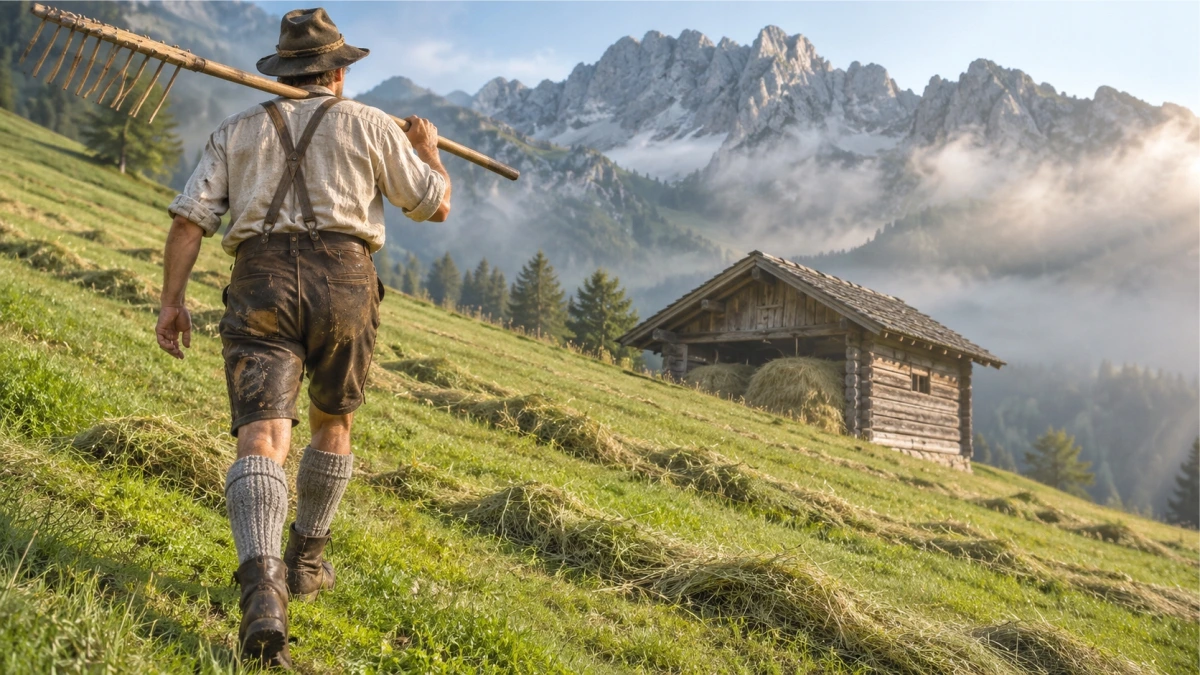
What Is the History of Lederhosen?
Lederhosen history begins with hard-wearing leather breeches that Alpine farmers and peasants in Bavaria wore as work clothing, continues through their adoption by nobles in the 18th century and a steep decline during industrialization, and ends with a revival by Trachtenverein clubs that made lederhosen Oktoberfest’s official attire in 1887.
The German word translates plainly as “leather breeches,” and the grammar hides a small surprise. One pair is a lederhose in the singular, while lederhosen is the plural that most English speakers use for everything. The word alone tells you what the garment was for: gear built to be knelt in, sat on and patched, long before anyone thought of it as a costume.
What strikes me every time I walk through this timeline is the order of events. The leather pants nearly vanished before anyone fought for them. The festival scene you see today, from the Munich meadow to small-town America, rests on a rescue that started in a handful of mountain villages in the late 1800s.
That rescue is the reason a garment made for muddy pastures now has a global spread. The sections below follow the leather through each phase, from the first hide pair to the finished set hanging in a festival tent.
Where Did Lederhosen Originally Come From?
Lederhosen originally came from the mountainous heart of German-speaking Central Europe, mainly Bavaria, Tyrol and the alpine provinces of Austria, where leather breeches were everyday gear for Alpine workers long before they became festival clothes.
Nobody sat down to design a regional look. Locals worked with what the valley supplied: cowhide and goatskin from their own animals, tanned and cut close to home. In steep, wet landscapes, a hide garment shrugged off thorns, rock and rain, and when it tore, it was mended rather than thrown away.
That is why the earliest pairs belong to the working class and not to any tailor’s pattern book. For centuries, the people wearing them were herders and field hands who needed one pair to last through seasons of hard use, and often far longer.
From handling older pairs, I have learned to read the wear pattern before anything else. The seat and the front of the thighs go dark and glossy first, a quiet record of the kneeling, hauling and sitting that this clothing was built to survive.
How Did French Culottes Shape the Lederhosen Design?
French court fashion handed lederhosen their basic silhouette, a fitted breech ending above the knee, which mountain tailors remade in leather during the 1700s.
The development was a swap, not an invention. Court breeches were made for salons and ballrooms; the Alpine version kept the shape and changed the material. The shorter leg used less fabric, so a pair came out cheaper, and it allowed free movement on a slope where long legs would snag and soak through.
The result was a blend of two worlds: an aristocratic cut carried in a peasant’s material. Retellings often flip the next part. People assume fashionable society imitated mountain dress first, but the shape travelled down from the courts, and only later did city wearers borrow the leather version back.
The short leg also took a long time to reach paper. The first written record of the above-knee Bavarian cut comes from August Lewald, who described it in Tyrol in 1835, generations after farmers had made it their standard.
Why Did Nobles and the Upper Class Start Wearing Lederhosen?
Bavarian aristocrats started wearing lederhosen because hide breeches outlasted the softer fabrics of the French aristocracy on long days in the forest with their hunters, and because dressing like the countryside became a fashionable statement.
The irony is legal. In 1644, Prince-Elector Maximilian I issued a dress code that marked leather breeches as lower-class clothing, the uniform of people who worked the land. By wearing them anyway, the court was playing with status rather than hiding from it.
Court pairs never looked like field pairs. Commissions for the palace were decorative, finished with ornament fit for royalty, and makers experimented with finer hides, including boarhide, alongside the usual cattle leather.
The trend gathered speed after the 1810 royal wedding in Munich, when courtiers saw ordinary guests in leather up close. That aristocratic chapter gave us the idea of the heirloom-grade pair, made well enough to be handed from father to son.
What Did the 1810 Royal Wedding Have to Do With Lederhosen?
The 1810 royal wedding that became the first Oktoberfest put lederhosen in front of the whole city, because ordinary guests arrived in the leather breeches they wore for everyday use, and the upper class took notice.
Many of those guests came straight from farm work. Their pairs were plain and durable, built for weather rather than ceremony. Watching them, Munich’s elites recognized something both practical and handsome, and in the following decades they wore lederhosen for riding, hunting and other outdoor activities.
What separated the wealthy pair from the working pair was the hide. Deerskin became the premium option: thinner and more supple than cattle leather, and noticeably pricier to make.
More than two centuries later, that same split still shows up at beer festivals across Germany. In one tent you can spot a hand-finished deerskin pair next to a sturdy cattle-leather pair that has clearly seen years of use.
Why Did Lederhosen Fall Out of Fashion in the 1800s?
Lederhosen fell out of everyday fashion during the nineteenth-century shift to factories and cities, when laborers left mountain labor behind and switched to low-cost cotton and denim workwear.
Industrialization changed what a working day looked like. A heavy hide breech made sense on a hay slope; it made far less sense on a factory floor, where cloth garments were lighter and easier to replace. Leather lost its practical edge in exactly the places where most new jobs were appearing.
The court abandoned the look at the same moment. The luxurious, decorated versions commissioned a generation earlier suddenly read as farmhand dress again, and aristocratic families wanted distance from anything tied to the countryside.
The garment hung on only in pockets of the Eastern Alps, where village life changed more slowly. That survival mattered: in 1883, a schoolteacher, Joseph Vogl, looked at those holdouts and decided they were worth defending. I would call this the most underrated turn in the story, because the tradition was never fully dead, just cornered.
Who Saved Lederhosen From Disappearing?
Lederhosen were saved by Joseph Vogl and the Trachtenverein costume clubs that grew out of his 1883 initiative, whose members insisted on keeping the original look and traditional shape of the garment while villages emptied.
The threat was real. Urban migration was draining rural life, younger people were buying mass-produced trousers in town shops, and a garment tied to a specific home region risked becoming a curiosity. Vogl’s answer was organization: give the clothing a club, and give the club a reason to meet.
The clubs ran on German pride and a longing for simpler times. Members turned up to gatherings in their valley’s pair and pushed back against shortcuts in cut or fit, which is why a well-made pair today still follows the old pattern so closely.
Each club carried its valley’s name, which turned the clothing into a badge of place rather than a marker of class. Similar clubs soon spread across the Eastern Alps, giving the revival a network instead of a single village.
When Did Lederhosen Become Official Oktoberfest Attire?
Lederhosen became official Oktoberfest attire in 1887, when the festival named them the proper wear for men, with the dirndl confirmed as the women’s counterpart.
That decision capped years of groundwork. Joseph Vogl’s group, the Association for the Preservation of the National Costume in the Leitzach Valley and Bayrischzell, had shown that a costume club could preserve a fading tradition, and Munich clubs formed through the 1880s to guard Bavarian cultural heritage in the capital.
Royal backing gave the movement weight. Ludwig II and Ludwig III both supported the costume revival, which made traditional dress respectable again in city circles. The table below sorts out who did what, since the names often get blurred together.
| Who | When | What they did |
| Joseph Vogl | 1883 | Founded the costume association in Bayrischzell and the Leitzach Valley |
| Munich clubs | 1880s | Organized costume preservation in the Bavarian capital |
| Ludwig II and Ludwig III | Late 1800s | Gave royal support to traditional dress |
| Oktoberfest | 1887 | Made lederhosen and the dirndl official festival wear |
Today both the short pair and the longer Bundhosen count as proper Oktoberfest wear, so the 1887 decision covers more styles than its authors likely pictured. If you prefer the knee-length style, browse our bundhosen bavarian clothing collection before festival season.
How Did Maximilian I’s 1644 Dress Code Affect Lederhosen?
Maximilian I’s 1644 dress code fixed leather breeches in law as working-class clothing, which shaped who wore lederhosen, and what a pair signaled, for well over a century.
Leather clothing itself is old. It may reach back to the Middle Ages, and its exact birthplace is disputed, with some historians pointing beyond Bavaria. What is clear is that knee breeches spread through fashion from the 16th century, and leather versions caught on through the sixteenth and seventeenth centuries, especially in Southern Germany.
Mountain households relied on locally available hides because they cost little and were easy to clean after a day outdoors. The Prince-Elector’s rule turned that practical choice into a social label. Once leather breeches were officially declared clothing of the working land, they became symbols of rank as much as tools.
Historians’ account of the period focuses on the court’s intent rather than on how farmers felt. My own read is that the label mattered far more to the people who later borrowed the garment than to those who wore it daily. That class history explains a modern-day quirk: lederhosen keep a down-to-earth image even at formal events.
What Is the First Written Record of the Short Bavarian Cut?
The first written record of the short Bavarian cut is August Lewald’s 1835 account from Tyrol, which describes the above-knee style that had already defined Alpine leather breeches for generations.
The cut itself was recognized much earlier. Roughly three hundred years ago, French observers labeled leather breeches with a front flap “Bavarian Style,” a sign that the design had its own identity while ordinary French breeches were common across Europe.
That flap, the drop-front Latz, is the feature that separates traditional leather shorts from generic shorts. Accounts disagree on timing: some place it in the 18th century, others date today’s flap to the 19th century, which suggests the design settled in stages.
Lewald’s description matters because it came from Tyrolean country, including what is now South Tyrol, where the short cut served as weather-resistant mountain wear. Festival wearers later added longer versions cut below-the-knee, but Lewald’s record shows the short leg came first. Whichever leg length suits your event, you can shop short or long lederhosen that keep the flap-front design.
What Were Traditional Lederhosen Made From?
Traditional lederhosen were made from cowhide, goatskin and deerskin, with boarhide used less often, because hide stood up to the harsh rainy weather of the Alps far better than woven cloth.
Each leather had a job. Cowhide and goatskin were the working hides, deerskin was the premium option for finer pairs, and heavy stitching at the seams kept everything together under strain. Compare that with the silk-and-satin world of the culottes that inspired the cut, and you see how thoroughly mountain makers rethought the material.
Leather’s real rival arrived from America. In 1873, Levi Strauss, a German-born immigrant, introduced blue jeans, and denim did for many workers what leather once had, at a fraction of the cost.
Materials still split the market today. Some makers now use sustainable materials or synthetic leather, and many modern pairs blend leather with denim or cotton. At the top end, a hand-finished pair can run over a thousand dollars, while thin counterfeit costumes in polyester only borrow the look.
How Do Lederhosen Styles Differ by Region?
Lederhosen styles differ by region mainly in cut details and decoration: Bavarian and Tyrolean pairs anchor the tradition, while Austria, Switzerland and Northern Italy each developed local takes on the same leather breech.
Bavaria is widely treated as the home base, and Tyrolean pairs on both sides of today’s border share the short cut and front flap. The Swiss link is more recent than the Bavarian and Austrian ones, while parts of Lombardy have older roots because their valleys resemble the German-speaking Alps in landscape and custom.
The clearest regional marker is embroidery. Valley motifs were stitched onto flaps so that people could read where a wearer came from, which is how these pants became such recognizable regional outfits.
After the World War periods, a postwar revival and the spread of Oktoberfest moved lederhosen from valley dress to festival dress. Tourists carried them home, and the United States now has its own lederhosen culture built around Oktoberfest events.
How Did Lederhosen Become a Worldwide Festival Outfit?
Lederhosen became a worldwide festival outfit because Oktoberfest itself went global, carrying the 1887 dress tradition to beer festivals far beyond Munich.
The festival’s founding story explains the pull. The 1810 celebration marked the marriage of Crown Prince Ludwig to Princess Therese von Sachsen, a five-day celebration held on a meadow that King Max I named the Theresienwiese after the bride.
That meadow still hosts the festival, and the 1887 dress tradition still applies there. The turnaround is striking when you remember the 1870s, when jeans looked set to replace leather breeches for good.
What keeps the global version honest is craft. Skilled artisans in Bavaria and Austria still cut and sew pairs by hand, and their work is why quality pairs keep the shape the clubs defended. In my experience, people who start with a cheap costume often come back for real leather the following year. When you are ready to make that switch, shop bavaria trachten lederhosen and compare cuts before your next festival.
FAQs
Is It Lederhosen or Lederhose?
Both are correct: lederhose is the singular German word for one pair of leather breeches, and lederhosen is the plural, though English speakers use lederhosen for one pair or many.
English treats the word the way it treats pantaloons, as a plural noun for a single garment. Online retail listings in the 21st century have made “lederhosen” the default, and cartoon caricatures of Germans spread that version long before. The word fits men and women alike, and German shops label the women’s cut Damen lederhosen. Women’s lederhosen gained popularity after 1880 and tend to be sleeker, often finished with beads, flowers and fine stitching.
Where Are Lederhosen Traditionally Worn?
Lederhosen are traditionally worn in Bavaria, modern-day Austria and Tyrol, with a newer tradition in Switzerland and older pockets in Northern Italy, including Lombardy.
Within that territory, the regional style evolution produced distinct variations: Bavarian, Tyrolean, Swabian, Salzburg and South Tyrol styles each carry their own details. Outside the Alps, lederhosen work mainly as festive dress for Oktoberfest and similar events. Knowing which region a design draws on tells you more about a pair than its price tag does. When a customer asks me whether a style is “authentic,” the honest answer usually starts with which valley the cut and flap come from.
When Did Women Start Wearing Lederhosen?
Women started wearing lederhosen in larger numbers after 1880, when Damen lederhosen designed specifically for women became popular alongside the costume revival.
Early women’s pairs drew on the same nostalgia that powered the costume clubs and were worn to festivals and weddings rather than to the field. Modern women’s pairs come in many colors and prints, and the range now extends to children’s sizes, so a whole family can dress for the same event. The cut itself has stayed close to the men’s original, with a fitted leg and front flap, which is why women’s pairs read as part of the same tradition rather than a novelty.
What Do the Embroidery Motifs osn Lederhosen Mean?
Embroidery on lederhosen originally showed the wearer’s home region, and each common motif carries a meaning, from royalty and courage to love and protection.
The embroidery grew far more decorative once lederhosen turned fashionable in the 19th century. These are the traditional motifs and what each one stands for:
- Bavarian Coat of Arms: courage and royalty
- Edelweiss: noble purity and love
- Stags: a force against evil
- Oak leaves: protection
When I look at a new pair, I read the flap first, because the motif shows what the maker wanted the wearer to carry. A pair with stags and oak leaves on the suspenders and flap tells a very different story from one covered in Edelweiss.