
What Is Lederhosen? Bavaria’s Leather Breeches Explained

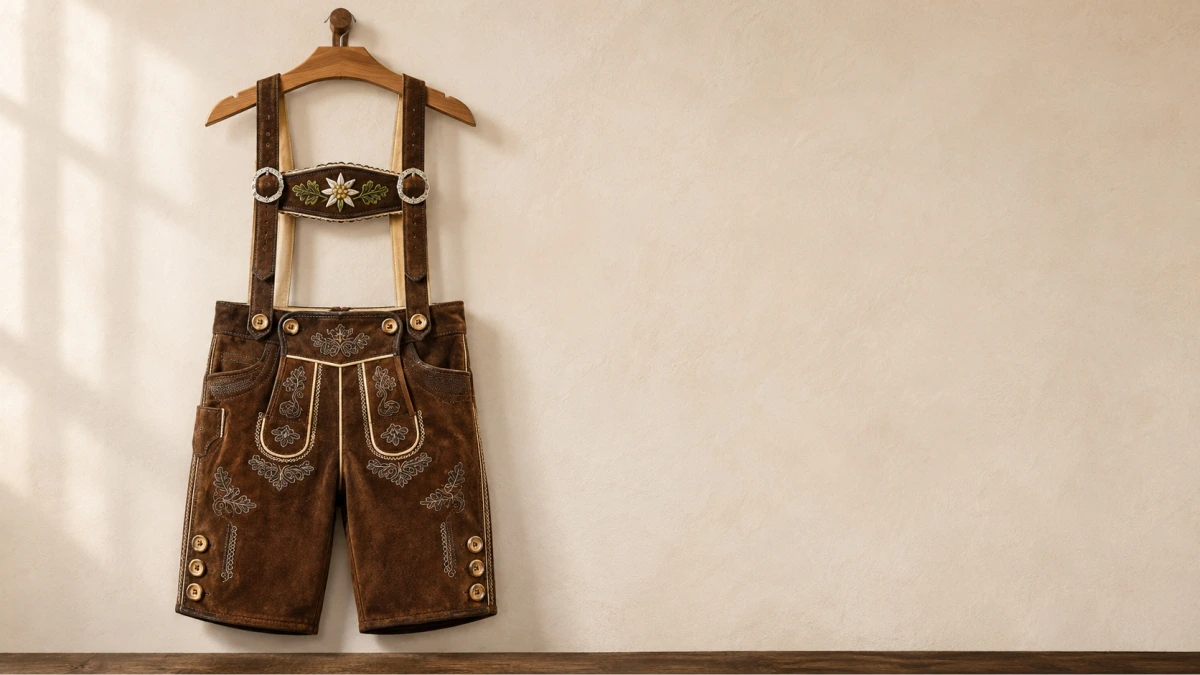
What Is Lederhosen?
Lederhosen are traditional leather breeches from the Alpine region of Southern Germany and Austria, cut from genuine leather such as deerskin, goatskin or cowhide, held up by embroidered suspenders and closed with a buttoned drop-front flap.
The garment dates back to the late Middle Ages, when Alpine farmers, herders and hunters needed trousers that would survive rock, brush and weather far longer than cloth. The name is pronounced LAY-der-ho-zen, and it covers short pairs, knee-length pairs and long ones alike.
Most people first meet the garment in Munich at Oktoberfest, which is why it so often gets mistaken for a costume. Put a real pair next to a party version and the difference is obvious within seconds: genuine hide is heavy, the stitching is dense, and the front closes with sewn-on buttons rather than snaps.
The sections below take a pair apart the way a tailor would, starting with the name and finishing with how to keep a pair in shape for decades.
What Does the Word Lederhosen Mean in English?
In English, the word Lederhosen translates to leather trousers, so the name describes what the garment is made of rather than how long it is.
German forms the word from two everyday nouns, one for the material and one for the garment. That is why a German speaker uses the same word for a summer pair cut above the knee and a pair that reaches the shoe. Neighbouring regions have their own versions: in Slovenia the garment is called irharice, and in South Tyrol, today part of northern Italy, the German name is used unchanged.
Knowing a handful of related words makes any product description easier to read. Hirschleder is deer leather, Ziegenleder is goat leather and Rindsleder is cow leather. The braces are Hosenträger, the side buttons are Seitenknöpfe, and the narrow pocket on the right leg is the Messertasche, cut to hold a Trachtenmesser, the knife that belongs to traditional Bavarian Tracht.
The vocabulary even crossed borders. When French tailors adopted the Bavarian button-front cut in the 18th century, they sold it à la bavaroise, “in the Bavarian way.” For women’s pairs, German has two names: Damen-Lederhosen is the standard one, and Ladyhosen is the informal nickname.
What Are the Parts of a Pair of Lederhosen?
A pair of Lederhosen is built from seven main parts: a buttoned front flap, two braces, a decorated chest strap that joins them, a set of pockets, side buttons, a waistband and finished leg ends.
Each of those parts exists because Lederhosen started as workwear for mountain work, and every detail solved a practical problem before it became decoration. The Bavarian front-flap version took shape between the 16th and 18th centuries, and by the 1700s it was the standard work garment of the Alps. Reading a pair part by part is still the quickest way to tell functional clothing from a party copy.
- Front flap: fastens across the waist and down both sides with hand-attached buttons, and a Charivari chain often hangs across it.
- Braces: run over the shoulders on top of the Trachtenhemd, whether that is a checkered shirt with a button-down collar or a fully buttoned white shirt for a formal day.
- Chest strap: links the two braces and carries the richest stitching, usually edelweiss, oak leaves or small hunting scenes.
- Pockets: two at the sides, one at the hip and a slim one on the right leg for a folding knife.
- Side buttons: run down the outside of each leg so the fit can be adjusted.
- Waistband: should grip the waist and thighs without digging in or limiting mobility when you sit, crouch or climb.
- Leg ends: short pairs finish flat, while longer pairs close under the knee with a button or a lace.
Construction ties everything together. The structural seams that take the strain are sewn with heavy 90-weight thread, while the decorative stitching follows regional patterns that shift from valley to valley.
What Does the Embroidery on Lederhosen Mean?
The embroidery on Lederhosen is a regional signature: its motifs and placement once showed where a wearer came from and, on finer pairs, how much that wearer could afford.
Most of the needlework sits on the front flap and on the Stegträger, the chest crosspiece that joins the braces, so the decoration lands exactly where people look first. That placement turned embroidery into a quiet badge of Bavarian identity long before the garment became a festival favourite. You can see that chest-strap stitching up close in our Lederhosen Suspenders collection.
Stitching also marked rank. In the 1770s–1780s, aristocratic families took up Lederhosen for riding and hunting, and nobles commissioned far denser work than a farmhand could pay for. A master craftsman today still works family crests into commissioned pairs, so the old status code has never fully disappeared.
The needle also tells you the price tier. Entry pairs are usually machine-stitched with simple patterns, semi-handmade pairs mix machine seams with hand work, and pairs with genuine hand embroidery start around $250–$500. Traditional thread colours sit on plain brown or similar hide, while some newer pairs experiment with bold colors and other modern touches, often repeated on matching belt buckles.
How Long Are the Different Types of Lederhosen?
Lederhosen come in four lengths: short pairs that stop above the knee, knee-length pairs, longer pairs that close just below the knee, and long pairs that reach the foot.
The length you choose decides most of the outfit, from socks to shoes. Short cuts made sense for climbing because nothing caught at the knee, while longer cuts kept the legs warmer on exposed pastures.
| Length style | Where the hem sits | Typical use |
| Short | Above the knee | Summer festivals, Alpine hiking, home gatherings |
| Knee-length | At or just under the knee | Weddings, First Communions, Trachten balls |
| Below-knee | Under the knee, where buttons or laces fasten at the cuff | Swabian and Baden-Württemberg tradition, the colder months |
| Long | Down to the foot | Formal events and cold days |
Socks follow the hem. Short pairs and knee-length trousers are classically worn with knee-high wool socks in off-white, gray, cream or hunter green, or with Loferl, the two-piece calf warmers worn over short socks. Ankle-length socks are a casual option for short pairs, and dark leather boots are an accepted alternative to low shoes.
Which Leather Are Lederhosen Made From?
Authentic Lederhosen are made from one of three hides: deer leather for the finest pairs, goat leather for a balanced middle option, and cow leather for tough, affordable pairs.
Leather won because cloth failed. Miners, herders and hunters in the Alps needed trousers that survived stone, thorns and weather, and hide outlasted fabric by years. Poorer workers often made do with goat or sheepskin, while the hides of deer and stags went to those who could pay for them.
Deer leather is still the top grade. A pair from a German tailor typically costs €1,000 or more, and craftsman-made deer pairs run €800–€1,500. A pair made from domestic leather costs far more than an import but can last a lifetime, and a tailor such as Bensmann goes further by using vegetable tanning on hides he prepares himself.
Cow leather is the honest entry point at roughly $150–$400. It feels rigid on day one but gradually stretches and shapes itself to the wearer. Most hides used worldwide are sourced from Pakistan and New Zealand, then shipped to factories in other countries.
Leather’s toughness is not just folklore. In Hamburg, police dog handlers wear leather trousers on duty because leather resists bites and tears better than cloth, a far cry from the flashy leather outfits seen on the Reeperbahn. Shoppers who avoid animal products will find the alternatives in the next section.
Can You Get Lederhosen That Aren’t Real Leather?
Yes, Lederhosen are also made from fabric and plastic-based materials, which cost less and wear cooler but do not age or last like real hide.
Suede sits between the two camps. It is the brushed underside of a hide, so it is still leather, yet it looks more casual and handles wet weather worse than smooth full-grain leather. Smooth hide is naturally more water-resistant, which matters on a festival day full of spilled drinks.
Woven pairs earn their place on hot days. Cotton and flax versions are more breathable than leather, which helps on a mild afternoon in beer gardens, and many buyers wear them as casual fashion rather than full traditional dress. Check the care label before cleaning, because fabric and leather need opposite treatment.
Plastic look-alikes are a different matter. Pairs under $50 are almost always imitations made for Halloween and themed parties, built to look right for one night rather than to last.
Real leather has modern versions too. Some newer pairs show scroll-like stitching and exposed seams in contrasting colors, and full-length Lange Lederhosen that reach the ankle are a modern reinterpretation of the old style, closer to leather pants than to shorts.
How Did Lederhosen Become a Symbol of Bavaria?
Lederhosen became a symbol of Bavaria by surviving a near-collapse in the 1800s and being rescued by a movement that tied the garment to regional pride.
The early lederhosen history spans a wide belt of mountains. Men across Bavaria, Austria, the Allgäu, Switzerland, Trentino-Alto Adige (once part of Austria-Hungary) and Alpine Slovenia wore the garment for farm work and even pheasant hunting. Alpine peasants and laborers valued it because leather survived wear that destroyed cloth.
The buttoned front became an international trend in the 18th century, before city fashion in the following century pushed rural dress aside and brought the garment close to near-extinction. Preservation clubs and royal backing reversed that slide, and the Munich festival first held for the wedding of Crown Prince Ludwig and Princess Therese gave Lederhosen a permanent stage.
That revival is why the garment now works as a national symbol and a traditional costume that families hand down through generations.
Who Wears Lederhosen Today?
Lederhosen are worn today by men, women and children in Bavaria and Austria, and by visitors at German heritage events around the world.
Men remain the core wearers, and men’s lederhosen are standard dress at gatherings of the Schützenvereine, the traditional shooting clubs. That role runs deep: King Ludwig III wore Lederhosen on Alpine trips, and by the early 20th century the garment had become the cultural uniform of Bavaria.
Women’s and children’s pairs fill out the picture. Women’s cuts are growing in popularity at German and Austrian festivals and are now an established option rather than a novelty, while children usually get a first pair young and pass it down as they outgrow it.
The big festival crowds keep the look visible. Munich’s Oktoberfest runs for 16 days, and the 2026 edition ran September 19 – October 4, 2026. Famous wearers include Arnold Schwarzenegger, Robert Downey Jr., Samuel L. Jackson, Richard Branson and Ed Sheeran, who have worn Lederhosen at Oktoberfest, at film premieres and on stage.
Where and When Do People Wear Lederhosen?
People wear Lederhosen at weddings, church and shooting festivals, Christmas markets and folk events across Bavaria and Austria, and at beer festivals and German heritage events abroad.
At home the calendar stays full. Schützenfeste, village folk dances, hunting events and family weddings all call for a pair, and many rural Bavarians in Upper Bavaria still wear one for ordinary errands. A well-made deer pair copes with rain and beer without complaint, which makes it practical for long days outdoors.
Comfort on those long days starts at the feet. Traditional Haferlschuhe with side lacing and an Alpine rubber sole handle uneven ground, and at festivals the shirt sleeves are usually rolled up on a blue-and-white check.
Abroad, the garment travels with heritage. About 45 million Americans report German ancestry, so Lederhosen are a central part of German-American heritage events, German-themed weddings, Renaissance fairs and Hofbräuhaus beer halls across the country.
How Are Authentic Lederhosen Made?
Authentic Lederhosen are made by preparing a hide, cutting it to a regional pattern, sewing and embroidering it by hand, and conditioning the leather before the buttons go on.
The hide sets the character of the finished pair. Tanned deer leather comes out soft, lightweight and tearproof, goat is flexible enough for fine stitching, and cow is sturdy but slow to give.
- Preparing the hide: the leather is treated and checked for flaws before any cutting starts.
- Shaping the panels: each panel is cut to a template that matches the region and the chosen length.
- Sewing: load-bearing seams go in first, then the decorative seams run down each leg.
- Embroidering: motifs are worked in silk or cotton thread, sometimes framed with braided trim.
- Finishing: the leather is conditioned and the buttons are sewn on one by one.
Seam count shows effort at a glance. Legs come in 3, 5, 7 or 9-seam versions, and more seams usually signal higher craftsmanship.
Hours of work set the tier. Goat pairs in the mid-range cost about $250–$600, hand-sewn deer pairs in the premium tier run $700–$1,500, and a fully bespoke pair at $1,500–$3,000+ is meant to become an heirloom, not a one-season purchase.
Why Do Lederhosen Prices Vary So Much?
Lederhosen prices range from under a hundred dollars to several thousand because the hide, the stitching method and the hours of work change sharply from one tier to the next.
Where a pair is made explains much of the gap. Lederhosen are a global business: the largest factories are in India, Sri Lanka and Hungary, producing in volume for festival season, while a workshop pair can take 40–80 hours of skilled labor to finish.
Method is the second factor. Full hand-stitching costs more than machine work, and top pairs are finished with natural oils and waxes rather than surface coatings. A deer pair that is cared for and develops a patina can last 30 to 50 years, which lowers its cost per wear dramatically.
Small fittings reveal the tier as well. Buttons in brass, antler or bone along the outer thigh, two side pockets, a hip pocket and a cleanly finished codpiece, the old name for the drop front, all add cost. Cheaper polyester and rayon synthetics cut the price but wear out sooner.
That range of styles and qualities is why it pays to compare pairs in person. When you shop traditional lederhosen, compare the hide, the stitching method and the fittings rather than the price alone.
What Do You Wear With Lederhosen?
Lederhosen are worn with a traditional shirt, wool socks, sturdy leather shoes and, for the full look, a felt hat, a vest or jacket, and a decorative chain across the front.
The shirt goes on first and is tucked in under braces that form an H-shaped harness over the shoulders. Traditional pairs have no belt loops, although a decorative Gürtel can sit at the natural waist, and some modern pairs swap the braces for a built-in harness top. If you like that waist detail, shop lederhosen with belt styles that match the colour of your leather.
Colour comes next. Classic pairs come in brown, dark green, tan or black, and some modern sets use mixed fabrics. Shoes look best when they echo the leather, so pairs in rich browns suit brown shoes. The chain across the Latz is the finishing piece many first-time wearers forget.
Motifs let the outfit say something. Oak leaves stand for strength and endurance, edelweiss for Alpine pride and resilience, and the Bavarian coat of arms, often found on belt fittings, for courage and royal heritage.
One practical note: knives are banned at Oktoberfest, so the knife pocket now usually holds a bottle opener. Couples often coordinate, with one partner in Lederhosen and the other in a Dirndl in matching tones.
Are Lederhosen Just a Costume?
No, authentic Lederhosen are traditional clothing rather than a party outfit, even though cheap copies flood the shops every autumn.
The price gap between the two is smaller than most people expect. A real entry-level pair in cowhide costs around $80–$200, and basic factory goat pairs start near $100–$150. Party versions are usually PU or microfiber made to look like leather, and a baggy, shiny fit gives them away, because real leather is cut to sit snug.
Bavarians defend the garment for a reason. In 1883, a schoolteacher named Joseph Vogl founded the first Trachtenverein, a club to preserve traditional dress, in Bayrischzell. King Ludwig II supported the cause in a letter, and similar clubs spread to Salzburg and Vienna.
Women’s and children’s pairs are equally authentic parts of that tradition, not novelty spin-offs.
What Are Some Surprising Facts About Lederhosen?
Lederhosen carry a few surprises, from their grammar to a dance-specific cut to an awkward link with the inventor of jeans.
Start with the grammar. Leder means leather and Hosen means trousers; the German singular is Lederhose, while English uses “lederhosen” for both the singular and the plural.
The garment’s biggest rival came from a Bavarian. Industrialization and urban fashion made country dress look like peasant clothing, and in the 1870s blue jeans arrived. Their inventor, Levi Strauss, was a Bavarian who had emigrated to San Francisco.
The comeback was organised. Clubs devoted to preserving Bavarian culture formed in Munich and other cities in the 1880s, and the garment went on to outlast two world wars.
There is even a dancer’s version. Plattlerhosen are cut for Schuhplatteln, a folk dance built on rhythmic slapping of the thighs and shoes, and the cut makes each strike louder. Festival chains add their own oddities, since a Charivari is often hung with coins or animal teeth.
FAQs
Are Lederhosen German or Austrian?
Lederhosen are both German and Austrian, because the garment belongs to the whole Alpine belt, from Bavaria and Tyrol to Liechtenstein and Slovenia. Bavarian, Austrian and South Tyrolean pairs differ in cut and embroidery, and the stitching once revealed a wearer’s home region; many outfits on both sides of the border are topped with a Tirolerhut. The fashion history source La Couturière Parisienne notes that leather breeches were once worn all over Europe by riders and hunters, with the buttoned front as the Bavarian addition. Germany even has a village named after the garment: Lederhose in Thuringia, home to 267 residents on the A9 motorway south of Leipzig.
Can Women Wear Lederhosen?
Yes, women can wear Lederhosen, and women’s pairs are a recognised alternative to the dress most people picture. Women’s versions have a tailored waist and a feminine cut, went mainstream in the early 2000s, and often carry floral designs. They are versatile too: add a Trachten vest or a cropped Janker and an Alpine felt hat with a feather for a festival, or wear them plainly at corporate Oktoberfest events and evenings in German restaurants and bars. When you’re ready to choose a pair, shop oktoberfest womens lederhosen and compare cuts before festival season. For sizing, one common rule is to go one size up from your jeans size and expect a slightly firm fit at first.
What Is the Difference Between Lederhosen and Bundhosen?
The difference between Lederhosen and Bundhosen comes down to how far down the leg they reach: Lederhosen usually means Kurze Lederhosen that end above the knee, around mid-thigh, while Bundhosen continue past the knee and are cuffed with buttons or laces. Short pairs suit warm weather, beer garden outings and anyone happy with lower legs exposed, while the longer cut gives more coverage in cold weather. The longer style is traditional in Swabia and the Black Forest, and Bundhosen is simply the German term for that cuffed cut.
How Should Lederhosen Fit?
Lederhosen should feel close-fitting, almost tight, when new, because real leather gives as you wear it. Standard sizes are cut slightly roomy, while authentic pairs are traditionally custom-tailored, with pattern cutting matched to region and length. Cowhide in particular is stiff at first, so do a squat test and picture yourself on steep slopes or a long festival bench before you decide. Check that the leg openings lie flat, with a simple hem that does not gape on short pairs, and that braces in V or H style rest evenly on the shoulders. Because the cut sits so close, underwear is a matter of taste today, though until the 1940s most wearers went without.
How Do You Clean Lederhosen?
Clean Lederhosen by wiping marks from the surface, airing the pair after every wear, and leaving deep stains to a leather professional; leather pairs should never be laundered like ordinary trousers. A well-kept pair can last 20–40 years, so treating it as disposable after one festival throws away a long-term investment. Fabric pairs in linen or heavy cotton, popular for warm autumn days, are the exception and should follow their own instructions.
How Long Do Lederhosen Last?
Well-made leather Lederhosen last for decades, and published estimates for quality pairs range from about two decades to half a century. The leather settles over the first 20–30 wears, and conditioning it with leather balm once or twice a year, or 2–3 times a year for pairs worn often, keeps it from cracking; a pair cared for this way can last 20+ years. That long life is why pairs were traditionally passed from father to son. Children’s pairs show it too: a first pair bought around ages 3–5 is often sized up to allow for growth and handed between siblings as hand-me-downs.
Are Lederhosen Only Worn at Oktoberfest?
No, Lederhosen are worn far beyond Oktoberfest, even though they were declared the festival’s official attire for men in 1887. Bavarians also wear them for Maifest on May 1, at the Christkindlmarkt, at wine festivals and on weekend trips to farmers’ markets, and Kniebundhosen are a common choice for formal days. Acceptance took time: in 1913 the Archbishop of Munich called Lederhosen immoral because the short cut showed the lower leg, and early club members caused a scandal by wearing them to church. The Catholic Church is more relaxed today and weddings in Lederhosen are allowed, proof that the garment stands for far more than beer and pretzels.
How Should You Store Lederhosen?
Store Lederhosen clean and fully dry: hang them in a closet for regular use, and for long-term storage pack them in an airtight container with silica bags to absorb moisture. Before putting a pair away, spot-clean marks with a damp cloth, use a little saddle soap on deeper dirt, and let the leather air-dry away from heat and direct sun. Never machine wash or tumble dry leather, and book professional leather cleaning for stubborn stains. In my own routine, I open a sealed box every couple of months to check that no damp has crept in, because trapped humidity is the one problem an airtight box cannot fix.