
Product categories
- Accessories
- Bundhosen
- Deerskin Lederhosen
- Dirndl
- Dirndl Purses
- Girls Dirndl
- Kids
- Kids Lederhosen
- Lederhosen Belts
- Lederhosen Men
- Lederhosen Sets
- Lederhosen Shoes
- Lederhosen Skirts
- Lederhosen Socks
- Lederhosen Suspenders
- Lederhosen Women
- Long Lederhosen
- Men's Oktoberfest Outfits
- Oktoberfest 2026 Sale
- Plus Size Dirndl
- Plus Size Lederhosen
- Trachten Jackets
- Trachten Shirts
- Trachten Vest
- Uncategorized
- Women's Oktoberfest Clothing
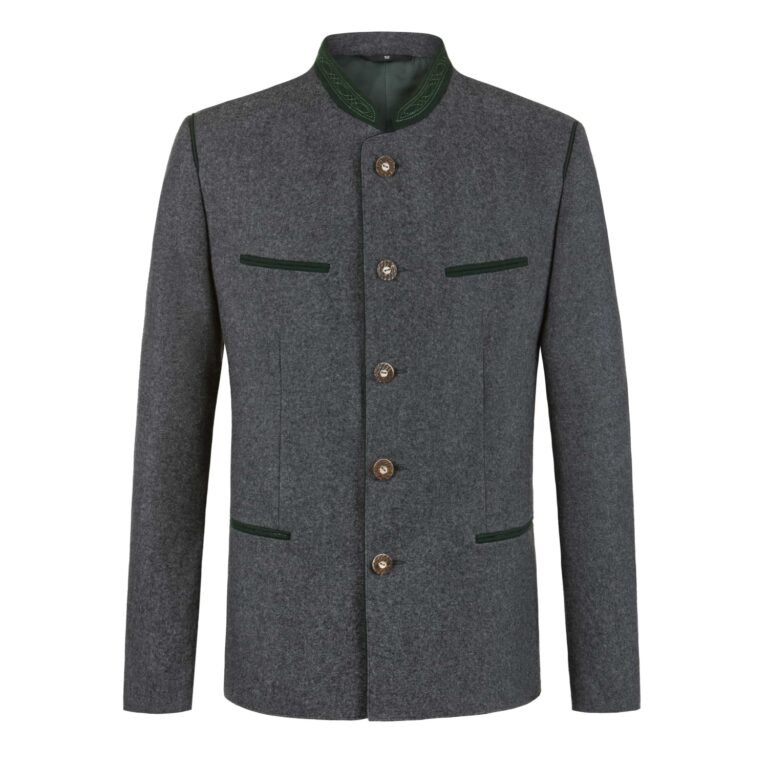
Men’s Dark Gray Wool Trachten Jacket
What Are Trachten Jackets?
Trachten jackets are traditional Bavarian and Austrian men’s jackets, usually cut from loden, boiled wool or linen and finished with a stand-up collar and horn buttons, bone buttons or antler buttons. They are worn over Trachten shirts and vests with Lederhosen, and a well-made one works just as well as everyday outerwear.
Most men first buy a Trachten jacket as the top layer of a festival outfit when they shop traditional oktoberfest clothing, and that is a fair place to start. It still undersells the garment. A jacket with real quality construction is a working piece of clothing, and in my experience it gets more wear beyond the festival than any other part of the outfit.
The German names on the label tell you what you are holding. A Trachtenjanker is the general word for a traditional jacket, while a Walkjanker is one made from knitted, felted wool. Cuts and trims differ in ways typical of the region they come from, so an Austrian jacket and a Bavarian one often look like cousins rather than twins.
The jacket also sets the formality of everything underneath it. Shirts and layers below can stay relaxed; the jacket on top decides whether the whole outfit reads as dressed up or casual.
What Details Make a Jacket a Trachten Jacket?
A Trachten jacket is defined by a few fixed details: a collar that stands upright instead of folding into lapels, buttons made of natural material, decorative trim, a pleat at the back and a fabric made from natural materials.
Those details carry centuries of tradition from Bavarian, Austrian and Tyrolean dress. Where a jacket follows a regional dress code, they are not optional. To conform to the uniform of a specific state or district, the collar, buttons and colours all have to match the local pattern.
Regardless of region, the fabric shows quality first. Dense felted wool, soft merino loden and textured tweed all hold the straight, boxy shape that separates a Trachten jacket from a sports coat. Thin fabric that creases at the elbows after an hour is the clearest sign of a costume piece.
The finishing is where European artisans show their hand. On an anthracite or marine jacket, green or brown piping should run straight along the collar and pockets with no puckering. That level of European craftsmanship and high-end tailoring is what keeps the heritage look sharp after years of wear.
Which Fabric Should Your Trachten Jacket Be Made Of?
Choose a Trachten jacket fabric by season and use: pure wool loden or boiled wool for autumn and winter, linen for summer, and a blend when easy care matters more than tradition.
The word on the label refers to the material, not the cut. A loden blazer, a boiled-wool bomber and a classic stand-collar jacket can all come from the same cloth, so I always read the fabric line before the style name.
| Fabric | How it is made | Colours in the range | Where it works |
| Loden | Wool woven loosely, then felted | Olive, charcoal | Cold days in the field and in town |
| Boiled wool (Walk) | Wool knitted, then felted | Gray, charcoal, beige | Festivals and everyday outerwear |
| Linen | Woven plant fibre | Beige, dark blue | Summer festivals |
| Velvet | Pile fabric | Black | Evening celebrations |
| Leather | Tanned hide | Light brown | Hard, rugged wear |
Wool earns its reputation for Alpine functionality. A dense felted jacket is built to last and handles the Bavarian outdoors as well as a beer hall. A fully lined jacket also slides over a vest more easily and keeps its shape for longer.
Blends sit between tradition and convenience. A striped jacquard cloth adds pattern without embroidery, and a zippered knit style moves more like modern clothing. For a timeless jacket you will still wear in ten years, wool remains the safer choice.
What Do You Wear With a Trachten Jacket?
Wear a Trachten jacket over a Trachten shirt and vest with lederhosen for Oktoberfest, or over a plain shirt with jeans or dark trousers for everyday wear.
A Trachten jacket is cut to layer: the chest and shoulders leave room for a shirt and vest underneath, so comfortable layering is built in rather than squeezed in. That is why I always suggest trying a jacket on over the vest you will actually wear with it.
Colour does most of the pairing work, and German labels often keep their original colour names. Schiefer is slate, Tanne is fir green, Moosgrün is moss green, Granit and Kiesel are stone and pebble greys, Schilf is reed, Hellgrau is light grey, Dunkelblau is dark blue and Stein-Blau is stone blue. Greens and stone greys sit easily over brown leather, while smoke and gray-blue jackets look cooler and suit dark lederhosen.
Small accents finish the outfit. A pocket square, a contrasting shirt under a plain jacket, or a jacket with black trim over a white shirt all add definition without adding pieces.
When a full jacket feels too formal, knitwear covers the same ground. A wool cardigan, traditional German sweaters or Alpine-inspired hoodies give a softer version of the look and elevate your wardrobe on days the lederhosen stay in the closet.
What Styles of Trachten Jackets Are There?
Trachten jackets come in two broad families: classic stand-collar jackets in wool or loden, and modern classics such as collarless and slim fit styles that add a sophisticated edge to the same tradition.
The classic family is the one most men picture: a straight cut, natural buttons and plenty of pockets. Some come with a matching vest in the same cloth, which gives you a complete traditional look without having to guess at colour combinations.
The modern family moves the details around rather than dropping them. A slim fit jacket with piped pockets suits a narrower build, and a collarless wool jacket with wooden buttons looks cleaner over an open-collar shirt. Fabrics widen as well: brown corduroy, black velvet for evenings, and a traditional leather jacket for men who want one piece to last for decades.
Labels can be confusing here because Tracht is a loosely used word. Many jackets sold under that name are authentic, German-made traditional styles rather than strict regional costume. That is perfectly fine, as long as the fabric and finishing hold up.
What Is the Difference Between a Tracht, Loden and Bavarian Jacket?
A Bavarian or Austrian jacket is any jacket with the regional traditional features, a Tracht jacket strictly follows the prescribed dress of one region, and loden and boiled wool describe the fabric rather than the style.
Most traditional jackets share a set of German terms, and knowing them makes product listings much easier to read:
- Stehkragen: the mandarin-style collar that stands upright instead of folding into lapels.
- Geweihknöpfe: antler buttons; horn and bone buttons fill the same role.
- Borte: the decorative trim stitched along the collar, cuffs and pockets.
- Quetschfalte: the back pleat that gives the jacket room across the shoulders.
- Leinen: linen, the fabric used for lighter summer jackets.
The fabric names work differently from the style names. Loden is loosely woven wool that goes through a long wet-finishing process called walken, which shrinks and felts the cloth. Boiled wool, or Walk, gets the same treatment but is knit first instead of woven.
“Boiled wool” is actually a misnomer, because the water is never boiling. Felting gives a better result with warm water worked through the cloth over several hours, and that slow process is what produces the dense, even surface you feel on a good jacket.
How Do You Find Your Trachten Jacket Size?
Find your Trachten jacket size by measuring your chest and matching it to the German size on the size guide; if you fall between sizes, size up.
Here is how to measure: wrap the tape around the fullest part of your chest with your arms relaxed, then measure your waist at the narrowest point, about an inch above the navel. I suggest measuring over a thin white shirt rather than bare skin, since the jacket will always sit over a shirt.
| German size | Chest (inches) | US size (approx.) |
| 44 | 36–38″ | S |
| 48 | 39–40″ | M |
| 52 | 42–44″ | L |
| 56 | 46–49″ | 2XL |
| 60 | 50–52″ | 4XL |
| 64 | 54–55″ | 6XL |
German jacket sizes run in even numbers, and these conversions are approximate, so always check the chart on the jacket you are buying.
Fabric changes how strict that chart is. A blend of polyester, viscose and a little elastane has some stretch, and a mix of cotton and virgin wool sits somewhere in between. A pure felted wool jacket has almost no give, so sizing up for a vest underneath matters most with the firmer fabrics.
Trachten Jackets FAQ
What Is the Difference Between a Trachten Jacket and a Trachten Vest?
A Trachten vest is a sleeveless layer worn over the shirt, while a Trachten jacket has full sleeves and goes on top of everything for cooler weather or formal occasions. Inside a warm festival tent the vest is usually enough on its own. Outdoors, or at a wedding, the jacket goes over the vest for a fully layered look. Wearing both is the most formal way to dress in Trachten. If you want that layered look, choose a vest from our Men’s Trachten Vests collection in a shade that works with your jacket.
Can You Wear a Trachten Jacket With Jeans?
Yes, a Trachten jacket works with jeans or chinos as well as with lederhosen. A plain or checked shirt keeps the look relaxed, and dark, straight-cut jeans suit the structured shape of a wool jacket best. This is the easiest way to get everyday wear out of a jacket you first bought for a festival.
What Shirt Should You Wear Under a Trachten Jacket?
Wear a Trachten shirt in white or a traditional check, such as red-white, green-white or blue-white, under a Trachten jacket. The shirt should support the jacket’s colour rather than compete with it. A white or green-checked shirt under a green jacket is a safe, classic combination. If a blue-white check suits your jacket better, shop lederhosen with blue shirt pairings for a coordinated outfit.
Should You Wear a Trachten Jacket Open or Buttoned?
A Trachten jacket can be worn open or buttoned, depending on the occasion and the temperature. Buttoned looks more formal and keeps the straight cut clean, which suits weddings and ceremonies. Open is more relaxed and shows off the vest underneath, which works well at festivals and outdoor gatherings.
How Do You Clean a Loden or Wool Trachten Jacket?
A loden or wool Trachten jacket rarely needs washing: air it out after wearing and dab small spots with a damp cloth. When a deeper clean is needed, follow the care label. Loden and leather jackets should go to a professional cleaner, while some knitted wool jackets can be hand washed in cool water and dried flat. Never put a wool jacket in the dryer.
Is a Trachten Jacket Warm Enough for Winter?
A loden or boiled-wool Trachten jacket suits cool autumn and spring days and mild winter days, but it is not a replacement for a heavy winter coat. The felted wool blocks wind and sheds light rain, which is why these jackets started out as outdoor wear in the Alps. For real cold, wear the jacket over a vest and a long-sleeve shirt, or add a coat on top.
Can You Wear a Trachten Jacket to a Wedding?
Yes, a Trachten jacket is a natural choice for a traditional or Bavarian-themed wedding. Choose a wool or loden jacket in a dark shade, such as charcoal, dark green or dark blue, and wear a vest and white shirt underneath. With lederhosen it reads as festive formal dress, and with dark trousers it works in place of a suit jacket. For the lederhosen themselves, shop black man lederhosen that pair cleanly with a charcoal or dark blue jacket.